![5 Best Social Media Platforms for Franchises in 2026 [Ranked]](/images/blog/en/best-social-media-platforms-franchises-2026/best-social-media-platforms-franchises-2026-og.webp)
Introduction
If you manage social media for a franchise network, you already know this: the playbook that works for a single-location brand simply does not apply to you. You are not choosing one platform for one audience. You are choosing platforms that need to scale across 50, 100, or 500+ locations, each with its own local audience, its own page, and its own engagement dynamics.
The platform landscape in 2026 presents both massive opportunities and serious pitfalls for franchise brands. Facebook still dominates local discovery. Instagram reshapes visual commerce. Google Business Profile has become the front door to local search. TikTok offers organic reach that other platforms lost years ago. And LinkedIn opens doors for B2B franchises and franchisee recruitment.
But every platform you add multiplies your management complexity. With 200 locations, choosing to be on Facebook, Instagram, and Google Business Profile means maintaining 600 active profiles. That is not a content problem. It is an infrastructure problem.
This guide breaks down each platform through the lens of multi-location franchise management. Not generic advice. Franchise-specific analysis based on real data, real challenges, and real solutions.
Table of Contents
- Why platform choice matters more for franchises
- Facebook: the foundation for franchise networks
- Instagram: visual storytelling at scale
- Google Business Profile: the local SEO powerhouse
- LinkedIn: B2B franchise marketing
- TikTok: the emerging opportunity
- Which platforms should your franchise prioritize?
- How to manage multiple platforms across 50+ locations
- Conclusion
Why platform choice matters more for franchises
A single-brand company can afford to experiment. Try TikTok for three months, see if it works, pivot. For a franchise network, every platform decision has a multiplier effect.
The local vs. national audience dilemma
National brand awareness campaigns and local customer acquisition are two fundamentally different goals. A franchise headquarters might want to promote a seasonal campaign nationwide. But a franchisee in Austin, Texas needs to reach homeowners within a 10-mile radius. A well-structured franchise local marketing playbook is what bridges these two levels effectively.
Social media algorithms in 2026 increasingly favor local, authentic content over corporate broadcasts. Facebook’s algorithm, for example, gives higher organic reach to posts from local business pages with genuine community engagement than to posts that look like corporate copy-paste. This is a direct advantage for franchise networks, but only if each location publishes unique, locally relevant content.
The cost multiplier
Every platform you add is not just one more channel. It is one more channel multiplied by your number of locations.
| Platforms | 50 locations | 100 locations | 300 locations |
|---|---|---|---|
| Facebook only | 50 pages | 100 pages | 300 pages |
| FB + Instagram | 100 profiles | 200 profiles | 600 profiles |
| FB + IG + GBP | 150 profiles | 300 profiles | 900 profiles |
| FB + IG + GBP + TikTok | 200 profiles | 400 profiles | 1,200 profiles |
Each profile requires content, moderation, review responses, and performance tracking. Without the right tools and strategy, the cost of management grows exponentially, while the actual publication rate by franchisees drops below 15%.
Algorithm penalties for duplicate content
Here is the hidden cost most franchise networks do not see. When 100 Facebook pages publish the exact same text and image on the same day, Meta’s algorithm flags this as non-original content and reduces organic reach by up to 80%. The same applies to Instagram.
This means that a well-intentioned headquarters campaign, distributed as identical copy-paste to all locations, can actually damage your network’s visibility rather than help it. Each location needs a unique variation of the message to avoid these penalties.
Facebook: the foundation for franchise networks
Despite all the talk about newer platforms, Facebook remains the most important social media platform for franchise networks in 2026. Period. Here is why.
Why Facebook is essential for franchises
Native local page structure. Facebook is the only major platform with a built-in Location Pages framework. Each franchise location can have its own page, connected to the parent brand page. This is not a workaround. It is a feature designed for multi-location businesses.
Audience demographics that match franchise customers. Facebook’s core audience in 2026 skews toward the 30-65 age range, which overlaps almost perfectly with the primary customer base for most franchise verticals: home services, restaurants, automotive, healthcare, real estate, and retail.
Local discovery and reviews. Facebook remains a significant local discovery tool. Customers search for businesses near them, read reviews, check hours, and make decisions, all within the platform. For franchises, this means each location’s page functions as a mini-website for local customers.
Facebook Business Suite for multi-page management. Meta’s Business Suite allows headquarters to manage multiple pages from a single dashboard. You can schedule posts, respond to messages, and view analytics across locations.
Marketplace and local commerce. For retail and restaurant franchises, Facebook Marketplace and local commerce features drive direct sales at the location level.
Facebook challenges for franchises
Duplicate content risk. This is the number one challenge. When a headquarters marketing team sends the same post to 100+ pages, Facebook’s algorithm detects the duplication and suppresses reach. The solution requires automatic content variation, not manual rewriting for each location.
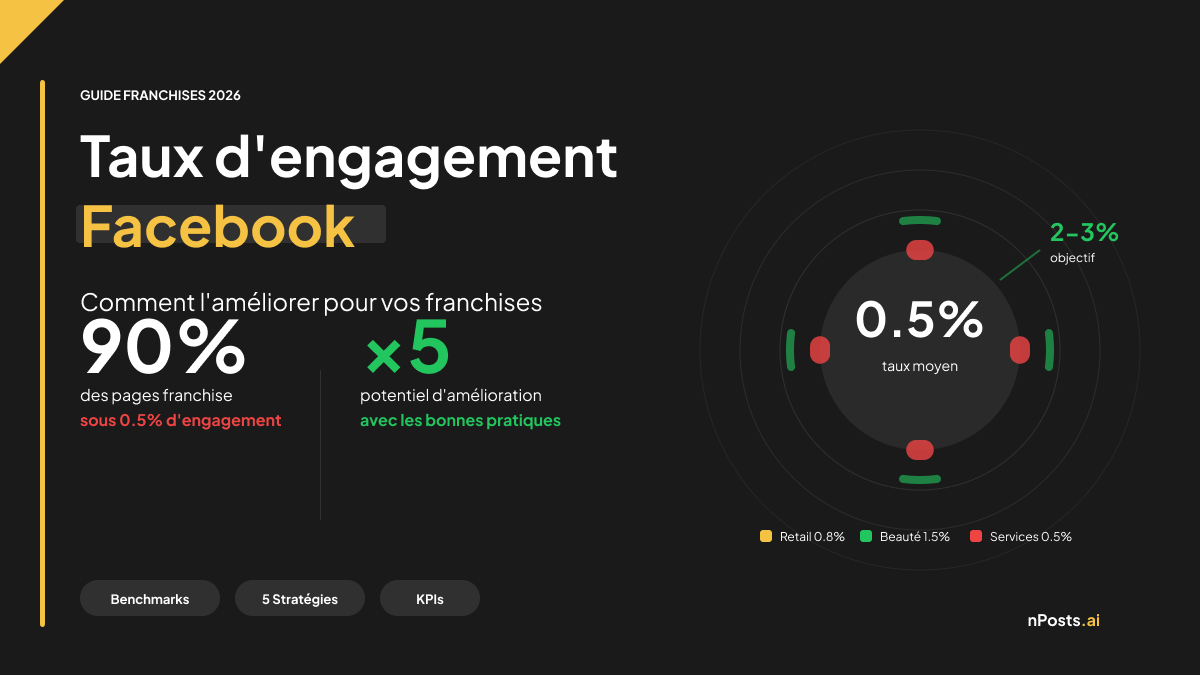
Declining organic reach. Facebook organic reach has been declining for years. In 2026, average organic reach for a business page post sits around 2-5% of followers. For franchises, this makes content quality and uniqueness even more critical. Generic, duplicated content gets close to zero reach.
Page management complexity. Managing 100+ Facebook pages requires proper admin access, content workflows, and approval processes. Without a centralized tool, this quickly becomes chaotic.
Recommended posting frequency: 3 to 5 times per week per location, with locally personalized content.
Instagram: visual storytelling at scale
Instagram has evolved from a photo-sharing app into a full visual commerce platform. For franchises with a strong visual identity, it is a powerful channel. But it comes with specific multi-location challenges.
Why Instagram works for franchises
Visual formats that showcase local experiences. Stories, Reels, and carousel posts allow each location to showcase its unique atmosphere, team, local events, and customer experiences. A Reel showing a behind-the-scenes look at a franchise location in Denver generates genuine engagement that a corporate stock photo never will.
Strong engagement rates. Instagram consistently delivers higher engagement rates than Facebook, especially for visual content. Average engagement rates for business profiles range from 3% to 6% in 2026, compared to 1-3% on Facebook.
Shopping and commerce integration. For retail franchises, Instagram Shopping allows each location to tag products, create shoppable posts, and drive in-store purchases directly from the platform.
Younger audience reach. Instagram’s core demographic is 18-45 years old, making it essential for franchises targeting millennials and younger Gen X consumers: fitness brands, fast-casual restaurants, beauty salons, fashion retail.
Meta Business Suite integration. Since Instagram and Facebook are both under Meta, managing both platforms together is streamlined. A single content creation effort can be adapted for both platforms, and analytics are unified.
Instagram challenges for franchises
No native local page structure. Unlike Facebook, Instagram does not have a built-in Location Pages system. Each franchise location needs a separate Instagram account, which means separate credentials, separate content calendars, and separate management. This is a significant operational burden at scale.
Content format complexity. Instagram’s algorithm in 2026 heavily favors Reels (short-form video) over static images. This means franchises need to produce video content regularly, which is more resource-intensive than creating static posts. Training 200 franchisees to create quality Reels is a substantial challenge.
Algorithm changes. Instagram’s content formats and algorithm priorities shift frequently. What works today may not work in six months. Franchise networks need to stay agile and update their content strategy regularly.
Recommended posting frequency: 4 to 7 times per week (mix of feed posts, Stories, and Reels), with local content variations.
Google Business Profile: the local SEO powerhouse
If Facebook is the foundation, Google Business Profile (GBP) is the front door. For any franchise with physical locations, GBP is non-negotiable in 2026.
Why GBP is non-negotiable
Dominates local search results. 46% of all Google searches have local intent. When someone searches “pizza near me” or “plumber in Chicago,” your Google Business Profile is what appears first, before your website, before your social media pages. For franchise networks, this means each location’s GBP listing is arguably the most important piece of digital real estate you own.
Customer reviews drive trust. In 2026, 93% of consumers read online reviews before visiting a local business. Google reviews are the most trusted review source. For franchises, the volume and quality of reviews on each location’s GBP directly impacts foot traffic and revenue.
Google Posts for each location. Google Posts allow each franchise location to publish updates, offers, events, and news directly in their Google listing. These posts appear when customers search for or view your business on Google Maps or Search. Most franchise networks massively underutilize this feature, creating an opportunity for those who act.
Complete business information hub. Hours, services, photos, Q&A, product catalogs, booking links: GBP is where customers go to get practical information before visiting. Incomplete or outdated profiles directly translate to lost customers.
Free visibility. Unlike social media platforms where organic reach is declining, GBP visibility is tied to search intent. When someone searches for your service in your area, a well-optimized GBP shows up. There is no declining algorithm to fight.
GBP challenges for franchises
Manual management at scale. Google does not offer a robust multi-location management suite comparable to Meta Business Suite. Managing GBP listings for 200 locations, keeping hours updated, responding to reviews, publishing Google Posts, updating photos, is extremely time-consuming without specialized tools.
No native scheduling. Google Business Profile does not have a built-in post scheduling feature. Each Google Post must be published manually through the GBP dashboard or via third-party tools. For a franchise network posting weekly updates across 100+ locations, this is a significant operational bottleneck.
Review management complexity. Each location receives its own reviews. Responding promptly and professionally to reviews across hundreds of locations requires either a dedicated team or automated tools with human oversight.
Recommended activity: Weekly Google Posts per location, same-day review responses, quarterly photo updates, and monthly information audits.
LinkedIn: B2B franchise marketing
LinkedIn is not for every franchise network. But for the right ones, it is an invaluable channel that most competitors ignore entirely.
When LinkedIn makes sense for franchises
B2B franchise networks. If your franchisees serve business clients, such as commercial cleaning, IT services, staffing agencies, consulting, or B2B supply, LinkedIn is where your customers make purchasing decisions. A local LinkedIn presence for each franchise territory can generate qualified leads.
Employee advocacy and employer branding. LinkedIn is the strongest platform for employee advocacy programs. When franchisees, store managers, and corporate team members share company content through their personal profiles, the organic reach multiplies dramatically. Studies show employee advocacy content receives 8x more engagement than content shared through brand pages alone.
Employee advocacy for franchise networks: the complete playbook
Franchisee recruitment. Finding new franchisees is a constant priority for growing networks. LinkedIn is where prospective franchise owners research opportunities. A strong corporate presence and thought leadership content on LinkedIn attracts higher-quality franchise candidates.
Thought leadership for headquarters. Franchise headquarters can use LinkedIn to position the brand as an industry leader, share network success stories, and build relationships with potential partners and investors.
LinkedIn limitations for franchises
No local page structure. LinkedIn does not offer location-based pages for multi-location businesses. Each franchise location would need its own Company Page, which is impractical for most networks. LinkedIn works best as a corporate-level and employee advocacy channel rather than a location-by-location marketing tool.
Smaller audience. LinkedIn’s active user base is significantly smaller than Facebook or Instagram. For consumer-facing franchises (restaurants, retail, beauty), the audience overlap is limited.
Content creation barrier. LinkedIn content performs best when it is professional, insightful, and personal. This requires a different content strategy than the visual, promotional content that works on Facebook and Instagram. Training franchisees to create LinkedIn-appropriate content is more complex.
Recommended activity: 2 to 3 corporate posts per week, combined with an employee advocacy program that encourages franchisees to share and comment on brand content.
TikTok: the emerging opportunity
TikTok is the platform every franchise marketer is asking about in 2026. The opportunity is real, but the challenges for multi-location management are significant.
TikTok for franchises
Organic reach is still strong. Unlike Facebook and Instagram, where organic reach has been declining for years, TikTok’s algorithm still offers substantial organic reach to quality content. A well-crafted 30-second video from a single franchise location can reach tens of thousands of viewers without any ad spend. This is a level of organic visibility that no other platform offers in 2026.
Short-form video is easy to produce locally. TikTok content does not need to be professionally produced. In fact, the platform rewards authentic, raw content. A franchisee filming a 15-second behind-the-scenes clip on their phone can outperform a polished corporate video. This aligns well with the franchise model, where local authenticity drives engagement.
Gen Z and younger millennial audience. TikTok’s user base skews younger, with the 16-35 age demographic dominating. For franchise brands targeting this audience, such as fast food, fitness, fashion, beauty, and entertainment, TikTok is becoming a primary discovery channel. Many younger consumers now use TikTok as a search engine for local businesses.
Viral potential. A single viral TikTok from one franchise location can generate brand awareness across the entire network. When a customer interaction video or a creative product showcase goes viral, the halo effect benefits every location.
TikTok challenges for franchises
No mature multi-location tools. TikTok’s business tools are still evolving. There is no equivalent of Facebook’s Location Pages or Meta Business Suite for managing hundreds of TikTok accounts. Each location needs its own account, and there is limited infrastructure for centralized management.
ROI measurement is difficult. TikTok excels at awareness and discovery, but tracking the path from a TikTok view to an in-store purchase remains challenging. Attribution models for TikTok are less developed than for Facebook or Google, making it harder to justify budget allocation to franchise leadership.
Content consistency risks. Giving 200 franchisees creative freedom on TikTok can lead to brand inconsistency. Without clear guidelines and approval workflows, the risk of off-brand or inappropriate content is higher than on other platforms.
Algorithm unpredictability. TikTok’s algorithm is powerful but opaque. Content that performs well one week may get zero reach the next. This unpredictability makes it difficult to build a reliable, repeatable content strategy across a franchise network.
Recommended approach: Start with a pilot program at 10 to 20 locations, establish content guidelines, measure results for 3 months, then decide whether to scale network-wide.
Which platforms should your franchise prioritize?
Not every franchise needs to be on every platform. The right platform mix depends on your industry, your audience, and your operational capacity to manage profiles at scale.
Platform recommendations by franchise type
| Franchise type | Essential | High priority | Worth testing |
|---|---|---|---|
| Quick-service restaurants | Facebook, GBP | Instagram, TikTok | LinkedIn (recruitment) |
| Retail / fashion | Facebook, Instagram, GBP | TikTok | LinkedIn (B2B wholesale) |
| Home services | Facebook, GBP | ||
| Beauty / wellness | Facebook, Instagram, GBP | TikTok | |
| B2B services | Facebook, LinkedIn, GBP | TikTok | |
| Automotive | Facebook, GBP | ||
| Real estate | Facebook, GBP, LinkedIn | TikTok | |
| Healthcare / dental | Facebook, GBP |
The universal minimum: Facebook + Google Business Profile
Regardless of industry, every franchise network should maintain active Facebook pages and Google Business Profiles for each location. These two platforms cover:
- Local discovery (Google searches and Facebook local search)
- Customer reviews and trust (Google reviews and Facebook reviews)
- Direct communication (Facebook Messenger and GBP messaging)
- Content distribution (Facebook posts and Google Posts)
This is the non-negotiable baseline. Everything else is additive based on your specific audience and resources.
The priority ladder
Tier 1 (essential for all): Facebook + Google Business Profile Tier 2 (high impact for most): Instagram (especially if visual product/service) Tier 3 (strategic value): LinkedIn (B2B, recruitment) or TikTok (younger audience) Tier 4 (experimental): Additional platforms based on niche audience
Common mistakes in platform selection
Mistake 1: Trying to be everywhere at once. Adding a new platform before mastering the ones you already have leads to thin, low-quality presence everywhere. Better to excel on 2 platforms than to be mediocre on 5.
Mistake 2: Ignoring Google Business Profile. Many franchise networks invest heavily in Facebook and Instagram but neglect GBP. This is a critical error because GBP captures high-intent local searches that directly convert to store visits.
Mistake 3: Choosing platforms based on hype, not data. TikTok generates excitement, but if your franchise serves a 45-65 demographic, Facebook and GBP will deliver far more ROI. Let your audience data guide your platform decisions, not trending articles.
How to manage multiple platforms across 50+ locations
Choosing the right platforms is only half the battle. The operational challenge of managing content across multiple platforms and hundreds of locations is where most franchise networks struggle.
The scale problem
Consider a franchise with 150 locations active on Facebook, Instagram, and Google Business Profile. That is 450 profiles to manage. If you post 3 times per week on each platform, that is 1,350 posts per week. And each of those posts should be unique to avoid duplicate content penalties.
No marketing team, no matter how large, can manage this manually. The math simply does not work.
Why generic tools fail at franchise scale
Standard social media management tools like Hootsuite, Buffer, or Sprout Social are designed for single brands managing multiple channels. They are not built for the franchise use case:
- Per-user pricing becomes prohibitive at 100+ locations
- No automatic content personalization per location (city, store name, manager)
- No anti-duplicate technology to generate unique content variations
- No “suggested” mode where franchisees validate pre-made content with a single tap
- No network-level analytics showing publication rate by franchisee
Franchise social media tools compared: which one stops duplicate content?
Why a franchise-specific tool is necessary
Franchise social media management requires a fundamentally different approach. The tool must function as a distribution channel from headquarters to local pages, not just a scheduling dashboard.
What franchise-specific tools deliver:
-
Automatic content personalization. Headquarters creates one post. Dynamic variables (
{{store}},{{city}},{{manager}}) automatically personalize it for each location. -
Anti-duplicate content technology. The tool generates unique variations of each post so that 100 locations never publish identical content. This protects organic reach from algorithmic penalties.
-
Simplified franchisee experience. The franchisee receives a push notification, sees a ready-to-publish post personalized for their store, and approves it with a single tap in 40 seconds. No content creation skills required.
-
Headquarters control with local authenticity. Approval workflows ensure brand consistency while giving franchisees ownership of their local pages.
-
Network-wide analytics. See publication rates, engagement, and reach across every location from a single dashboard.
How nPosts.ai solves the multi-platform challenge
nPosts.ai is built specifically for franchise networks. It replaces email-based content distribution with a mobile-first platform that gets headquarters content published across all local pages.
Key capabilities:
- 3 publication modes: automatic (no franchisee action needed), suggested (1-tap approval), and participative (franchisee adds local content)
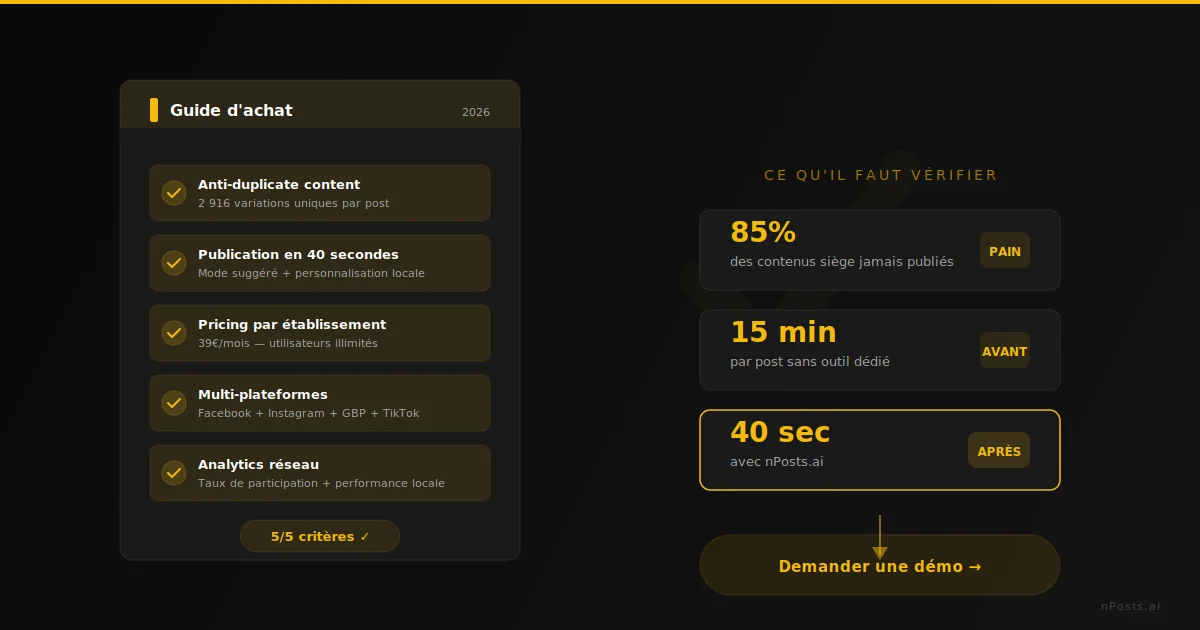
- Patented anti-duplicate technology: generates 2,916 unique combinations per post (9 hooks x 9 bodies x 9 CTAs x 4 angles), ensuring every location’s post is algorithmically unique
- Facebook + Instagram publishing with Google Business Profile integration in Q1 2026
- Transparent pricing: from €59/location/month for Meta platforms (nStart plan), with volume discounts for larger networks
- Unlimited users: every franchisee, regional manager, and headquarters team member has access at no extra cost
The result? Networks using nPosts.ai see their franchisee publication rate jump from 15% to 80%+, with each post maintaining unique content that the algorithm rewards rather than penalizes.
Frequently asked questions
What are the essential social media platforms for a franchise ?
Facebook and Google Business Profile are the mandatory baseline for every franchise network, regardless of industry. Facebook provides a native local page structure and reaches the 30-65 age demographic, while GBP captures 46% of all Google searches with local intent. nPosts.ai lets you manage both platforms from a single dashboard.
How many social media profiles does a franchise network need to manage ?
The number of profiles scales quickly: a network with 150 locations active on Facebook, Instagram, and Google Business Profile manages 450 active profiles, potentially requiring 1,350 posts per week. This is why a franchise-specific tool like nPosts.ai is essential to automate management at scale.
Is TikTok suitable for franchise networks in 2026 ?
TikTok offers exceptional organic reach and primarily attracts the 16-35 age group. However, the platform still lacks mature multi-location tools and ROI measurement remains challenging. The recommended approach is to start with a pilot program at 10 to 20 locations before scaling network-wide.
How do you avoid duplicate content penalties on franchise social media ?
When 100 pages publish the same content, Meta’s algorithm reduces organic reach by up to 80%. The solution is to generate unique variations for each location. nPosts.ai uses anti-duplicate technology that creates 2,916 unique combinations per post, ensuring every publication is seen as original by the algorithm.
Do franchise networks need a specialized social media management tool ?
Yes. Generic tools like Hootsuite or Buffer are not designed for the franchise use case: they offer no automatic per-location personalization, no anti-duplicate technology, and no single-tap approval mode for franchisees. A specialized tool like nPosts.ai increases franchisee publication rates from 15% to over 80%.
Conclusion
Choosing the right social media platforms for your franchise network in 2026 comes down to three principles.
First, start with the fundamentals. Facebook and Google Business Profile are essential for every franchise, regardless of industry. They cover local discovery, customer reviews, and community engagement. Master these before adding more platforms.
Second, let your audience guide your expansion. Instagram is high-impact for visual brands. LinkedIn opens doors for B2B franchises. TikTok offers organic reach for younger demographics. Add platforms based on where your customers actually spend time, not on industry hype. For a detailed tools comparison covering pricing and anti-duplicate capabilities, see our dedicated article.
Third, invest in infrastructure before content. The biggest challenge for franchise networks is not choosing platforms. It is managing hundreds of profiles across multiple platforms without drowning in operational complexity or destroying visibility through duplicate content. The right franchise social media management tool transforms this from impossible to automated.
The key takeaways:
- Facebook + GBP is the mandatory baseline for all franchises
- Each platform you add multiplies management complexity by your number of locations
- Duplicate content from copy-paste distribution kills your organic reach
- A franchise-specific tool with anti-duplicate technology is the only way to scale
- Publication rate (15% to 80%) matters more than platform count
Your franchise network’s social media success is not about being on every platform. It is about being effective on the right platforms, with unique content at every location, published consistently by your franchisees.
Ready to see how nPosts.ai manages multi-platform publishing for franchise networks? Request a personalized demo
Related articles
- TikTok Strategy for Franchises in 2026: The Complete Guide
- TikTok vs Instagram for Franchises: Which Platform Should You Choose?
- Best Franchise Social Media Management Tools Compared (2026)
- Franchise Social Media Management: The Complete 2026 Guide
- How to Manage 50+ Facebook Pages for Your Franchise
- Facebook Engagement Rate: How to Improve It for Franchises
- Employee Advocacy for Franchise Networks: The Playbook
- Instagram Content Formats for Franchises: 2026 Guide
Article published February 2026. Platform features and pricing evolve regularly. Contact each platform and tool vendor for the latest information.
![SOCi Alternatives: 5 Best Franchise Social Media Tools [2026]](/images/blog/en/social-media-tools-franchise-comparison/social-media-tools-franchise-comparison.png)