A customer walks into your franchise in Bordeaux on a Tuesday. They find the same colors, the same welcome, the same promise they experienced at the Lyon location they visited last month. You’ve spent years building this consistency in the physical world. But open the Facebook pages of your 80 locations: how many still respect your brand identity?
If the answer makes you uncomfortable, you’re not alone. I’ve spent 25 years in franchising — first as a franchisee audiologist, then working with networks on their digital presence. And I can tell you that in most networks, social media is the last territory where brand consistency isn’t controlled. One franchisee publishes a homemade visual with the wrong colors. Another hasn’t posted in six months. A third launches an unauthorized promotion that contradicts your pricing positioning.
The result: a brand that says one thing at the national level and a hundred different things locally. And consumers who, faced with this cacophony, move on to the competition.
This guide shows you how to regain control — without falling into micro-management. You’ll find the data proving consistency’s impact on your results, the five pillars to lock down, the three possible organizational models, and a method to audit your franchise network’s brand image in less than 30 minutes.
Why brand consistency is the #1 factor for social media performance in franchises
The statistic that changes the conversation at your executive meeting
Brands perceived as consistent across their social media channels generate up to 33% more engagement than those whose image varies from one channel to another (Lucidpress, Brand Consistency Report 2024). More impressively: companies with unified branding across all channels see revenue increases of up to 23% (Forbes, 2024).
For a network of 100 locations, these percentages aren’t abstract. They translate into store visits, Google reviews, local word-of-mouth amplified by algorithms. Each local page that publishes within brand codes strengthens the signal. Each page that deviates weakens it.
What brand inconsistency actually costs
The cost of brand inconsistency in franchising is rarely measured because it’s dispersed. It doesn’t show up on an invoice. But it’s very real.
The first impact, the most direct: consumer confusion. When a prospect discovers your brand on Instagram through a local page whose tone, visuals, and message have nothing to do with your national website, they hesitate. I’ve seen this concretely in an audiologist network: one franchisee was publishing humorous memes on Facebook while the brand’s positioning was 100% medical and reassuring. Customers arrived at the store not knowing what to expect. This hesitation is enough to send them to a competitor whose local presence inspires confidence.
Second impact, more technical: dilution of local SEO. Google evaluates the consistency of NAP (Name, Address, Phone) signals and brand elements across platforms. Inconsistent local pages send contradictory signals that penalize your visibility in local search results.
Then there’s internal erosion, which we systematically underestimate. Franchisees who see other franchisees posting anything without consequences eventually abandon digital communication. “If nobody checks, why should I bother?” Network publication rates drop, and with them, overall network visibility.
And there’s a fourth cost, more recent: AI visibility. When a consumer asks ChatGPT or Google Gemini “which franchise network should I recommend for [your sector],” AI models rely on the consistency of web signals to formulate their answer. A network whose local pages send contradictory messages is less likely to be mentioned than one perceived as uniform and professional. This is the new frontier of AI visibility in franchising.
The unique paradox facing franchises
Unlike a single-location business, a franchise must solve an impossible equation: be the same everywhere AND unique everywhere. Customers want to recognize the brand. But they also want to feel that YOUR store’s Facebook page speaks to THEM, about THEIR neighborhood.
This paradox is what makes local marketing strategy in franchising so tricky. And it’s exactly what the five pillars below allow you to solve.
The 5 pillars of brand consistency on social media
Pillar 1: Visual Identity
Your logo, colors, typography, photographic style, and publication templates form the most visible foundation of your brand. A consumer forms a first visual impression in less than 0.05 seconds (Missouri S&T, 2012). If your 80 local pages each use a different avatar or approximate colors, this first impression fragments.
Practically speaking, the most frequent deviations in franchises are these: one franchisee crops the logo by cutting off the baseline, another uses a blue “almost” identical to the official brand blue, a third creates their own visuals with fancy fonts. Taken individually, each of these seems minor. Multiplied across 80 locations, they dissolve brand identity.
The solution isn’t sending a 40-page PDF that nobody reads. It’s providing locked templates — where editable zones are clearly marked and everything else is fixed. A well-designed template makes compliance easier than deviation: the franchisee only needs to add their photo and change the text, the rest is automatic. We detail this approach in our guide on franchise visual identity on social media.
Pillar 2: Tone and Voice
Does your brand speak the same way in Marseille and Lille? Tone is more subtle than visuals, and therefore harder to control from a distance. A franchisee responding to comments with sarcastic emojis when your brand aims to be helpful and professional creates a dissonance that customers immediately perceive.
When I’ve worked with networks on this issue, the breakthrough always came from the same exercise: putting side-by-side the responses of 5 franchisees to the same type of customer comment. The gaps jumped out at you. The solution fits on one page in your social media charter for franchises: authorized vocabulary (and what’s forbidden), concrete examples of standard messages for recurring situations, and the level of formality expected per platform.
Pillar 3: Publication Frequency and Rhythm
A network where some franchisees post four times a week and others once per quarter sends an inconsistency signal to both algorithms and consumers. Social platforms reward consistency. A shared editorial calendar — even a minimal one — ensures each location maintains a baseline publishing rhythm.
The problem is rarely lack of willingness. Most franchisees want to post. But between managing the store, customers, orders, and admin, social media publishing comes last. On Monday, the franchisee thinks “I’ll post Wednesday.” By Wednesday, they’re swamped. By Friday, they think “next week.” Three months pass.
The ideal for a franchise is to provide at least 3 to 4 pieces of ready-to-publish content per week, which franchisees can post with one click or personalize slightly. This is the Suggested Playlist model: headquarters proposes, field executes. The content is there, at the right time, in the right format. The franchisee just needs to hit “publish.” And when even that click is too much, the Auto Playlist takes over.
Pillar 4: Content Quality
Unequal content quality between local pages is the most common symptom of a franchise network struggling on social media. Some pages publish professional visuals designed by headquarters. Others post blurry photos taken with a smartphone in a poorly lit store.
Setting a minimum standard doesn’t mean demanding perfection. It means defining what’s publishable (correct framing, sufficient lighting, visible logo) and what isn’t. A simplified two-page photo guide with visual “yes” and “no” examples generally suffices.
Pillar 5: Responsiveness to Interactions
The last pillar is often overlooked: response time to comments, reviews, and private messages. According to a Sprout Social study (2024), 76% of consumers expect a brand response on social media within 24 hours.
In a franchise network, this responsiveness depends on who’s responsible for moderation. If it’s the franchisee, you need to provide response templates and escalation rules. If it’s headquarters, you need tools to manage multi-location social media at scale.
HQ vs Field: Who Posts What? The 3 Organizational Models
The question “who manages social media?” is the first a franchise marketing director must answer. In 25 years in the sector, I’ve seen both extremes — and the damage each produces. There’s no universal answer, but the landscape boils down to three models.
Model 1 — Fully Centralized: HQ Posts for Everyone
Headquarters creates and posts content on all local pages. Franchisees don’t intervene.
This model guarantees perfect consistency. Zero risk of missteps. But it has a cost: content remains generic. No photos of the local team, no neighborhood events, no personalization. The consumer senses the page is “corporate” and engagement drops.
An optical network that centralizes everything will have the same “World Sight Day” post on its 120 pages — same visual, same text, same posting time. Facebook and Instagram algorithms detect this duplication and reduce the reach of each identical instance. The paradoxical result: posting on 120 pages reaches fewer people than posting on 20 pages with varied content.
This model works for networks with fewer than 20 locations or in heavily regulated sectors (healthcare, finance) where every publication must be legally validated.
Model 2 — Fully Decentralized: Each Franchisee Manages Their Accounts
The opposite. Each franchisee is autonomous on their social media. Headquarters may provide guidelines, but doesn’t intervene in posting.
Advantage: maximum authenticity, hyper-local content, immediate responsiveness. Disadvantage: it’s the Wild West. Some franchisees excel, others never post, and others still post content that harms the brand.
What we observe in practice, network after network: roughly 15% of franchisees are “champions” who post regularly and well. 35% post occasionally, with variable quality. And the remaining 50%? Inactive. Zero posts. Overall network performance is capped by this silent majority.
This model only works in very mature networks with franchisees trained in digital and a brand culture deeply embedded.
Model 3 — Hybrid: HQ Proposes, Field Executes
This is the model that works for most networks — and the one most commonly deployed. It comes in several variants.
Assisted Free Style: headquarters provides a library of content (visuals, texts, calendar) and the franchisee chooses what to post, personalizes it, and posts it. Works for networks with engaged franchisees.
Suggested Playlist: headquarters plans a posting calendar for each week. The franchisee receives ready-to-go content, personalizes it if desired, and posts with one click. This is the optimal balance between consistency and personalization.
Auto Playlist: headquarters programs automatic posting on local pages, with pre-personalized content (location name, address, hours). The franchisee does nothing. Works for networks where franchisees neither have the time nor desire to manage social media.
Whatever model you choose, the challenge is to personalize local content without losing consistency. The next section explains how.
| Model | Consistency | Authenticity | HQ Effort | Franchisee Effort | Best For |
|---|---|---|---|---|---|
| Centralized | ★★★★★ | ★★☆☆☆ | High | None | < 20 locations, regulated sectors |
| Decentralized | ★★☆☆☆ | ★★★★★ | Low | High | Mature networks, trained franchisees |
| Hybrid | ★★★★☆ | ★★★★☆ | Moderate | Light | Majority of networks (20-500+ locations) |
How to Create a Social Media Charter Your Franchisees Actually Follow
Most franchise social media charters share a common flaw: they’re long, abstract, and never consulted after initial training. For a charter to actually be followed, it must be short (10 pages maximum), visual (more examples than text), and accessible (in a tool franchisees already use).
The 7 Essential Sections
Your charter must cover these seven sections, no more.
The first section defines your brand’s objectives and positioning on social media. Not a strategic essay — one sentence. Example: “Our local social media pages show that our locations are vibrant, welcoming, and connected to their communities.”
The second section frames visual identity: logo, exact colors (hex codes), authorized typefaces, and links to templates to use.
The third section establishes tone and vocabulary: words to use, words to avoid, level of formality, emoji usage.
The fourth section suggests a typical calendar: how much to post per week, which days, what formats (photo, video, carousel, story).
The fifth section lists illustrated Do’s and Don’ts — ideally using actual screenshots from your own network.
The sixth section describes the validation process: who validates what, in what timeframe, with what tool. A process that’s too heavy (every post must be approved by HQ within 48 hours) kills responsiveness and demotivates franchisees. A process that’s too light (no verification) opens the door to deviations. The right compromise: publications using pre-approved templates need no validation, original content goes through a quick approval process (24 hours max).
The seventh section covers crisis management: what to do when facing negative buzz, defamatory reviews, or posting errors. The 3 rules: don’t delete, don’t respond while emotional, escalate to HQ. Include 2 or 3 template responses the franchisee can use immediately while awaiting HQ guidance.
We detail each section with templates in our dedicated guide: social media charter for franchises.
The Fatal Error: The Overly Restrictive Charter
A charter that prohibits everything produces the opposite of the intended effect. The franchisee, paralyzed by fear of making mistakes, stops posting altogether. And a silent page is worse than a slightly imperfect one.
The right approach is to define a clear framework with explicit room for maneuver. The franchisee must know what they CAN do without asking permission — post a photo of their team, share a local event, relay customer feedback — as much as what they CANNOT do.
Local Personalization: Finding the Balance Between Consistency and Authenticity
The 80/20 Rule Applied to Franchise Social Media
The formula is simple: 80% of content is framed by headquarters (visuals, messages, national promotions). 20% is produced locally by the franchisee (team photos, local events, local flavor).
This 80/20 ratio isn’t arbitrary. It reflects algorithm reality: social platforms favor accounts publishing varied, authentic content. A 100% corporate feed is perceived as advertising. A feed with local touches generates more comments, more shares, more store visits.
Data confirms this: according to Socialbakers (2023), posts incorporating a local element (geolocation, location mention, team photo) generate on average 2.3x more engagement than generic posts broadcast identically across a network of pages. The Instagram algorithm in particular values content triggering local proximity interactions — comments from local customers, store tags, shares within the geographic area.
What’s Personalizable (and What Never Is)
The logo, baseline, primary colors, and website link are never modifiable. That’s the non-negotiable foundation.
Conversely, several elements benefit from localization: photos of your team in-store (consumers want to see faces), local events and neighborhood partnerships, customer testimonials from your specific location, HQ-validated geotargeted offers, and news related to local life.
The pitfall is anarchic personalization: a franchisee modifying the logo “to make it more fun,” another using an Instagram filter that distorts brand colors, a third posting an unauthorized promotion at -50% that contradicts your pricing positioning. These deviations aren’t malicious — they’re symptoms of insufficient guidance or lack of adapted tools.
After 25 years in franchising, I’ve seen this situation in dozens of networks: the franchisee doesn’t want to harm the brand, they just want to bring their store to life locally. That’s a healthy instinct. The HQ role isn’t to suppress it, but to channel this energy within a framework that protects brand identity while allowing local authenticity to breathe.
For deeper insight on this topic, see our article on local personalization in franchising.
The Duplicate Content Problem: When Too Much Consistency Kills Visibility
There’s one case where excessive consistency becomes problematic: when identical content is posted word-for-word on 80 local pages. Facebook and Instagram algorithms detect duplicate content in franchises and reduce the reach of each identical post. The result: you post on 80 pages but reach fewer people than if you’d posted on 10 pages with varied content.
The solution is producing unique variations from the same message. The concept stays identical, but the text, hook, and sometimes visual change from page to page. This is the principle of anti-duplication content: one HQ message, unique versions, n locations.
Audit Your Network’s Consistency in 30 Minutes
Before fixing, you must measure. A quick consistency audit identifies locations deviating and priority correction areas.
The 10-Point Scoring Grid
For each location, evaluate these 10 criteria on a scale of 0 to 2 (0 = not compliant, 1 = partially, 2 = compliant).
Start with the most visible: are the avatar and cover photo the official logo in proper format? Next, colors and fonts in recent publications. Is the bio and account description — location name, address, hours, link — complete and up-to-date?
After the basics, move to content: is the tone of publications aligned with the charter? Has there been at least one post in the last 7 days? Are photos of publishable quality — correct resolution, good framing, sufficient lighting?
The last four criteria often reveal the real problems: hashtag and network mention usage, response time to comments (under 24 hours is the minimum), consistency across Facebook, Instagram, and Google Business Profile (all three should tell the same story), and compliance with network offers — no unauthorized local promotions.
A score of 16-20 indicates excellent consistency. Between 11-15, adjustments are needed. Between 6-10, urgent correction is required. Below 6, a complete overhaul of the location’s social presence is advisable.
Find the complete downloadable grid in our dedicated article: audit your franchise network’s brand image.
The 5 Red Flags Requiring Immediate Action
Some deviations can’t wait until the next quarterly audit.
The first red flag is a modified or distorted logo. This touches the trademark itself — it’s legally problematic and visually destructive. The second is an unauthorized promotion by HQ: a franchisee launching “-50% everything” on their Facebook can trigger a domino effect where customers at other locations demand the same offer.
The third is an aggressive or inappropriate response to a customer in a public space. One mishandled comment can go viral and affect the entire network’s image — not just that one location’s. The fourth is manifestly off-brand content: a post contradicting the brand’s values or using a tone radically different from positioning. The fifth is a page inactive for more than 30 days: in the consumer’s mind, a store that stops posting may have closed.
To detect these in real-time, set alerts on brand mentions and conduct a quick monthly check on a sample of 10-15 local pages. Some multi-location social media management tools offer dashboards that automatically flag anomalies: inactive pages, posts without brand visuals, missed response time targets.
Tools for Managing Consistency at Scale
Managing brand consistency across 50 or 200 local pages without dedicated tools is a doomed effort. Tools fall into four categories.
Planning and Publishing Tools
They allow you to schedule posts across multiple pages simultaneously. Legacy solutions (Hootsuite, Sprout Social, Agorapulse) work well for centralized accounts, but hit their limits when managing 50 or 200 distinct local pages with personalized content for each.
For franchise networks with dozens of local pages, specialized tools like nPosts.ai, Swello, or Facelift offer multi-page distribution features with local personalization. The key criterion to evaluate: does the tool allow you to post different content on each local page from a single HQ brief, or is it limited to posting the same post on all pages?
Templates and Assets Tools
Canva for Teams has become the standard for providing franchisees with locked templates. The advantage: the franchisee can change text and photos, but not colors, logo, or layout. Other solutions like Frontify or Bynder centralize all brand assets in a library accessible to the entire network.
Validation and Workflow Tools
For networks requiring pre-publication validation, tools like Planable or Kontentino allow you to create approval circuits: franchisee submits, HQ validates, post is scheduled.
Multi-Location Analytics Tools
Without page-by-page measurement, you’re flying blind. You need to see which locations perform, which are slipping, and why. The best social media management tools for franchises integrate multi-account dashboards with KPIs per location.
Priority metrics to track for evaluating consistency are publication rate per location (how many of your stores posted at least once this week), visual compliance score (on a sample), average response time to interactions, and engagement gap between your most and least active franchisees. An engagement gap exceeding 10x between your best and worst franchisees signals your support system isn’t working for part of the network.
The Differentiating Factor: Anti-Duplication
A challenge specific to franchises is the ability to produce unique content for each local page from a single HQ message. Without this capability, networks are condemned to either duplicate content (penalized by algorithms) or unmanageable manual production beyond 20 locations.
Take a concrete example. A 100-location network wants to post 3 times per week on each local page. That’s 300 posts per week, or 1,200 per month. If each post must be unique to avoid duplication penalties, it’s humanly impossible to write them manually with a 2-3 person HQ team.
This is where AI enters the picture. Tools like nPosts.ai automatically generate variations of each post: the message stays the same, but the expression changes from page to page. We call it the “Lego Engine”: the same concept assembled differently produces thousands of unique combinations. (Transparency: that’s our product, so we’re biased — but the duplication problem at scale is real, regardless of which tool you choose.)
Real-World Case: From 15% to 80% Publishing Rate in 3 Months
This case is composite — inspired by several supported networks, with realistic but anonymized numbers. Take a 65-location optical network in France. Starting situation: only 10 stores posted regularly on Facebook and Instagram. The other 55 had existing but inactive or inconsistent pages. The network’s marketing director had a 2-person team at headquarters.
Month 1: Audit and Charter
The HQ team audited a sample of 20 local pages with the 10-point grid. Average score: 7/20. Most common gaps: non-compliant avatars, posts with non-branded visuals, and incomplete bios.
In response, an 8-page social media charter was created — visual, with “yes/no” examples drawn from the network’s actual pages. It was presented via videoconference to all franchisees during a 45-minute session.
Month 2: Templates and Calendar
Headquarters created a library of 30 Canva templates covering the most frequent use cases: product announcement, store event, customer testimonial, seasonal offer. Each template was customizable in only two zones: photo and headline text. Everything else — logo, colors, layout, font — was locked.
The team also defined three support levels based on franchisee profile. The “autonomous” (about 20% of the network) received the library and calendar, publishing themselves with personalization freedom. The “assisted” (about 50%) received ready-to-post publications each week, with the option to add a local touch. The “passive” (30%) were identified for auto-publishing in month 3.
In parallel, a weekly editorial calendar was established: 3 posts per week, with content provided the preceding Friday. Franchisees only had to choose and post.
Month 3: Automation and Results
For the 30 franchisees still not posting despite provided tools, the network activated auto-publishing with location-personalized variations. Each post automatically included the store name, address, and a unique hook. The franchisee had nothing to do — but their store was visible on social media with brand-compliant content.
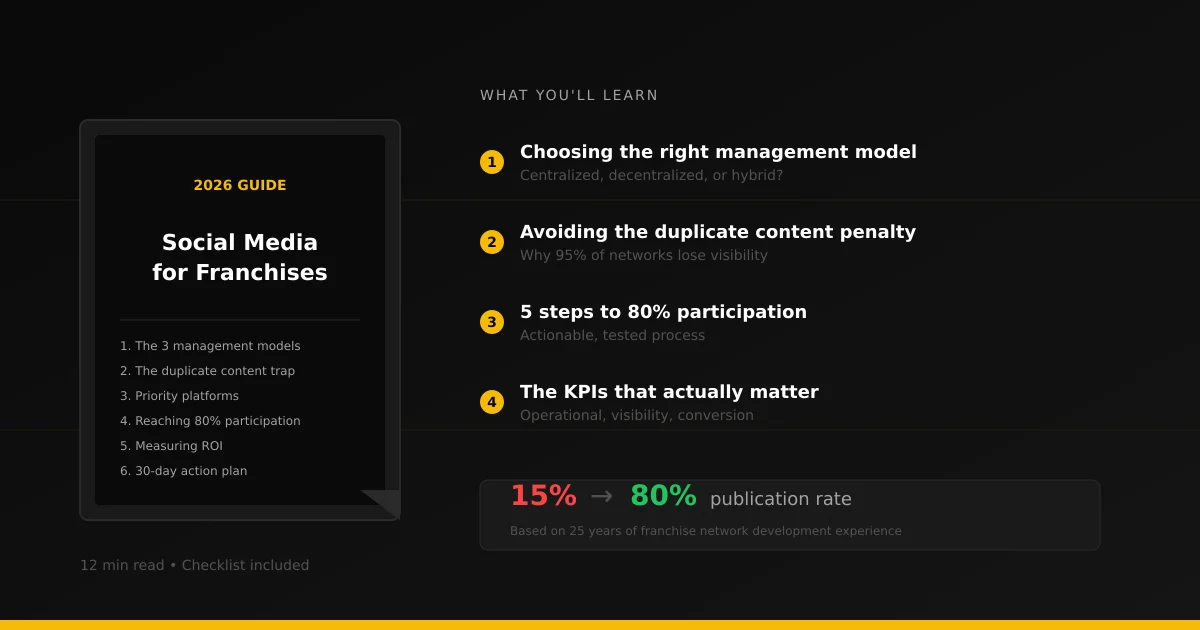
Result at 90 days: network publication rate jumped from 15% to 80%. Average engagement per post increased 45%. Average audit consistency score went from 7/20 to 16/20. And an unexpected effect occurred: several “passive” franchisees who now saw content on their page started adding their own local posts to supplement it. The mechanics reversed: instead of asking franchisees to post (and going unheard), HQ showed them what regular publishing produced — and some naturally took over.
The key wasn’t choosing between control and freedom. It was offering the right support level for each franchisee profile: autonomous ones publish with templates, assisted ones receive a playlist, passive ones go auto. And the door always stays open for a franchisee to gain autonomy when ready.
What This Experience Taught Me
If I started over tomorrow with another network, I’d change one thing: I’d activate auto-publishing for inactive franchisees in month 1, not month 3. The classic mistake is believing you must convince everyone before taking action. In reality, results convince better than speeches.
The other lesson is that a charter alone changes nothing. It must be accompanied by tools making compliance easier than non-compliance. And “one size fits all” doesn’t work in franchising — each franchisee has different digital maturity, and your system must adapt to this diversity.
FAQ — Brand Consistency in Franchises
How do you maintain brand consistency on franchise social media?
Brand consistency in franchising rests on systems, not good intentions. You need a clear, visual social media charter franchisees actually consult, tools making compliant posting easy (templates, ready content, editorial calendar), and regular audits — minimum quarterly — to catch deviations before they spread.
Who should manage social media in a franchise: HQ or franchisee?
There’s no single answer. The most effective model for most networks is hybrid: HQ creates content and framework, franchisee personalizes and posts. For networks where franchisees lack time or skills, auto-publishing with local personalization is a strong alternative.
What’s the cost of brand inconsistency for a franchise?
Brand inconsistency impacts three dimensions: consumer trust (lower engagement and store traffic), digital visibility (algorithm penalties on duplicate or poor-quality content), and internal dynamics (franchisee demoralization when the network seems to have lost control of its image). Studies estimate an inconsistent brand can lose up to 23% of potential revenue.
How do you create a social media charter for a franchise?
An effective charter covers seven sections: objectives, visual identity, tone and vocabulary, posting calendar, illustrated Do’s and Don’ts, validation process, and crisis management. It should not exceed 10 pages, should be primarily visual, and should be accessible in a tool franchisees already use daily.
What tools manage a franchise network’s social media?
Tools fall into four categories: multi-location planning (nPosts.ai, Hootsuite, Agorapulse), templates and assets (Canva for Teams, Frontify), validation and workflow (Planable, Kontentino), and multi-account analytics. The deciding factor for a franchise is the ability to generate unique content for each local page from a single HQ message, avoiding duplicate content penalties.
You run a franchise network and brand consistency on your social media is slipping away? Request a demo of nPosts.ai and discover how to move from 15% to 80% network publication rate — with unique content for each location.