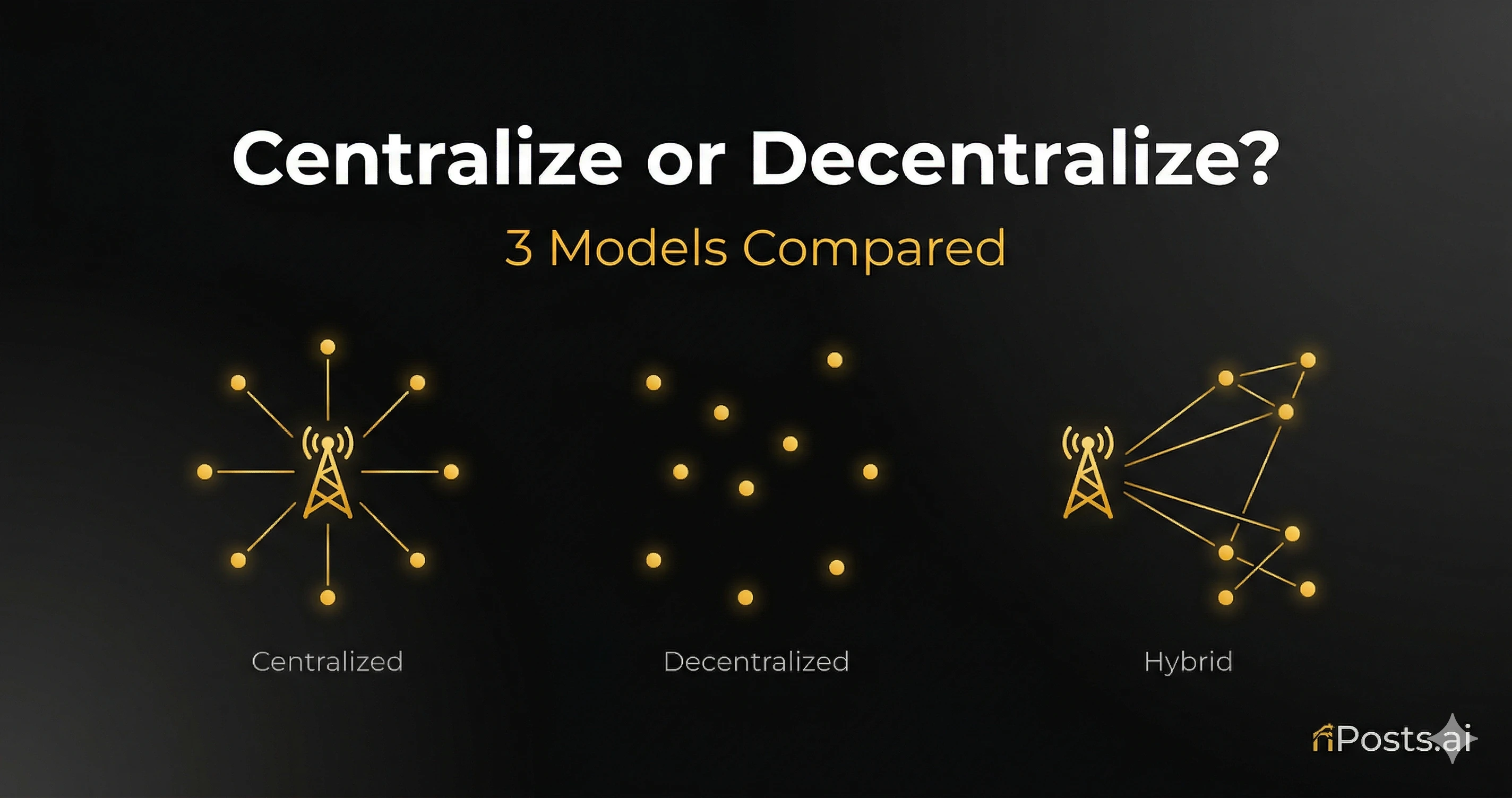
Choosing your organizational model for franchisee social media is never trivial. It’s the difference between a cohesive, impactful presence… or exactly what you see in 85% of franchise networks: complete chaos, zero engagement, and franchisees waiting for HQ to do the work.
For six years at Afflelou — before building nPosts.ai to solve this problem — I saw all three models. Small networks locked down at HQ losing all local credibility. Franchisees given free rein publishing dubious content or nothing at all. And progressively, the best networks finding the hybrid balance. Not by luck. By experimentation.
The HQ vs. Field Dilemma: Why No Extreme Works
85% of locations don’t publish anything on social media. That’s the number that keeps you up at night if you run a network. The one that obsesses you at HQ.
The trap of total centralization? Your content becomes impersonal. Franchisees feel like puppets. Local customers see messages that could apply to any store. Low engagement. Comments? Nobody there to respond directly. At Afflelou, we tried it. Result: 800 accounts, 1 voice, 0 local vibe.
The illusion of total decentralization? You create 50 different strategies. Some franchisees excel, others post dubious content, many do nothing at all. No HQ visibility into what works. No consistency for customers visiting multiple locations.
The truth: there’s no universal solution. What changes the game is your network size, the real digital maturity of your franchisees (not what they claim), and the team you have at HQ.
Here are the three models. Find which fits your context.
Model 1 — Fully Centralized: HQ Posts for Everyone
The principle: HQ creates, approves, and publishes all content on all location accounts. Franchisees are passive.
Advantages
- Maximum consistency — One voice, one strategy, zero deviation
- Operational efficiency — One team, not a hundred
- Guaranteed compliance — No unapproved posts
- Centralized reporting — Single view of network performance
Disadvantages
- Content that speaks to no one — Creating a post that sounds authentic for Paris AND Marseille in the same tweet? Impossible. So you create generic content. Customers feel it.
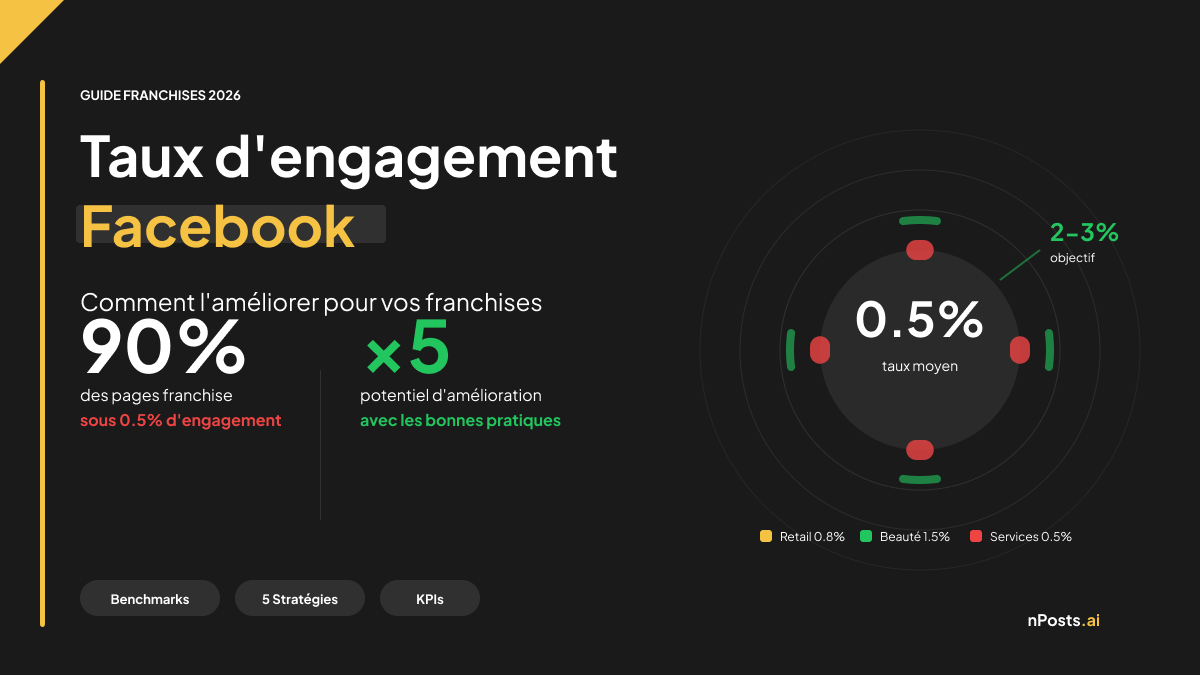
- Local engagement collapses — 0.8% engagement average instead of 3-4% in hybrid model
- Passive franchisees — They watch posts like spectators. No ownership, no pride
- No reactivity — Local event Tuesday? HQ approval comes Friday. Too late.
- Customer comments unanswered — Or HQ responds 48h later. Customers don’t wait 48h.
When It Works
- Networks < 20 locations (HQ can absorb the load)
- Highly regulated sectors (pharma, finance, healthcare)
- Franchises in launch phase (need total control)
Concrete Example
At Afflelou, we centralized product launches and national campaigns. But managing 800+ stores by hand? You hit the same wall: either your HQ team clings to control (losing reactivity) or you loosen up (reverting to decentralized). There’s no middle ground in pure centralization. That’s why most large networks abandon this approach beyond 50 locations.
Model 2 — Fully Decentralized: Each Franchisee Manages Their Accounts
The principle: HQ defines strategy and brand guidelines. Each franchisee manages their own accounts, creates, posts, engages.
Advantages
- Maximum authenticity — Posts reflect on-the-ground reality
- Strong local engagement — Customers recognize their store, their employees
- Reactivity — Post today’s event in 10 minutes, not 10 days
- Franchisee ownership — Feels like theirs
- Infinite scalability — Add 100 locations, zero HQ burden
Disadvantages
- Brand inconsistency everywhere — 50 locations = 50 ways to talk about you. Customers visiting two stores don’t even recognize they’re the same network
- Wild quality variance — One franchisee posts professional content, the neighbor posts a blurry photo. Same platform, your logo
- Zero damage control — A franchisee writes something awkward and it stays live 5 days. Costly in regulated sectors (audio, optics, healthcare)
- The 85% inertia persists — You hoped “giving freedom” would change everything. Spoiler: it doesn’t. Most franchisees still find 36 reasons not to post
- HQ reporting = nightmare — How do you measure network performance if every account uses different hashtags and posts at different times?
When It Works
- Very mature networks (franchisees trained, strong digital experience)
- Brands with very strong local identity (regional cuisine chains, independent restaurants)
- Rare in reality
Model 3 — Hybrid: HQ Proposes, Field Publishes
The principle: HQ creates varied content and adapts it for each location or offers multiple versions. Franchisees receive ready-to-post content (or easily modifiable), and publish in 1 click.
This is what we recommend in 90% of cases. Here’s why.
Three Variants of the Hybrid Model
1. Free Style Assisted
- HQ proposes a content template (text + visual) each week
- Franchisee can slightly adapt it (add local info, change a phrase)
- Direct publishing by franchisee
Good for: Networks with semi-engaged franchisees, sectors where personalization matters (salon, beauty)
2. Suggested Playlist
- HQ prepares 2-4 weeks of varied content (promotions, educational, behind-the-scenes, products)
- Each location gets a personalized playlist for their area
- Franchisees publish per calendar, in suggested order
Good for: ~50-300 location chains, competitive sectors (restaurants, optical)
3. Auto Playlist
- HQ prepares content and selects playlists
- Auto-publish at fixed time across all accounts
- Comment moderation and responses remain franchisee responsibility
Good for: 300+ location chains, highly recognizable brands, need systematic publishing
Hybrid Model Advantages
- Consistency WITH local truth — Your content stays coherent but speaks to reality. 3-4x more engagement than pure centralization
- Franchisees who actually post — Not by obligation. By habit. Because it’s 1 click and relevant to them
- HQ team breathes — You prepare content once, each location adapts in 5 minutes. Not 15 hours/week copying and pasting
- Optimized timing — HQ sets calendar (preventing chaos), franchisees publish in their timezone
- Local adaptability without anarchy — A franchisee can add a local promo or seasonal info. HQ still sees everything going out
- Single HQ dashboard — All locations, one place to see performance, trends, failures
Real Disadvantages
- It’s more complex to implement — You can’t just send a PDF with instructions. You need a tool, process, real discipline. Not just wishful thinking
- Franchisees still need training — Even if it’s 1 click, you spend 30 min on the phone with each. Not 5 minutes
- HQ does MORE work, not less — You create fewer pieces overall, but you adapt them. It’s a trade-off: more varied creation, fewer frantic iterations. Some HQ teams find this easier. Others don’t.
How to Choose the Right Model for Your Network
Here’s a simple decision tree to position yourself.
┌─────────────────────────────────────────────────────────┐
│ How many locations do you have?                          │
└─────────────────────────────────────────────────────────┘
         │
    ┌────┴──────────────────────┬──────────────────────┐
    │                            │                      │
    ▼                            ▼                      ▼
 < 20 locations              20-150 locations       150+ locations
    │                            │                      │
    │                            ├──────────┬───────┐   │
    │                            │          │       │   │
    ▼                            ▼          ▼       ▼   ▼
Centralized              Hybrid recommended  Hybrid   Hybrid
(HQ 100%)               (HQ 60%)            (HQ 40%)  (HQ + Auto)
                        Franchisee 40%      Franchisee 60%

Also check:
• Franchisee digital maturity (scale 1-10)?
• HQ resources dedicated to social media?
• Regulated sector yes/no?
• Strong local brand identity yes/no?
Scoring Grid
If you have 20-150 locations (most networks), here’s how to score your position:
| Criteria | Points | Your Situation |
|---|---|---|
| Franchisee digital maturity average | 0-3 = Centralized ; 4-6 = Hybrid ; 7-10 = Decentralized | |
| HQ Resources | 0 people = Decentralized ; 0.5 = Hybrid ; 1+ = Centralized possible | |
| Strong Regulation | Yes = +2 toward Centralized ; No = neutral | |
| Importance of Local Location Identity | Very important = Decentralized ; Medium = Hybrid ; Low = Centralized |
Interpretation: If your total score leans Hybrid, that’s probably your best choice.
Distributing Roles: Who Does What Concretely
Once you choose your model, clarify responsibilities. Here’s a simplified RACI matrix adapted to all three models.
Centralized Model
| Activity | HQ | Franchisee |
|---|---|---|
| Content creation | R | — |
| Content approval | A | — |
| Publishing | R | — |
| Comment responses | R/Consults Franchisee | — |
| Reporting | R | Provides local data |
Decentralized Model
| Activity | HQ | Franchisee |
|---|---|---|
| Content creation | Defines strategy | R |
| Content approval | Brand guidelines (quarterly audit) | R |
| Publishing | — | R |
| Comment responses | — | R |
| Reporting | Aggregates franchisee data | Transmits data |
Hybrid Model (Suggested Playlist)
| Activity | HQ | Franchisee |
|---|---|---|
| Content creation | R | Adapts (optional) |
| Content approval | R | — |
| Publishing | Provides calendar | R |
| Comment responses | Escalation support | R |
| Reporting | Consolidates | Handles locally |
Legend: R = Responsible (executes) ; A = Approves ; Consults = Opinion required ; — = Doesn’t participate
FAQ — Franchise Social Media Organization
Q: Should all locations use the same accounts, or separate accounts?
Separate accounts (one Facebook for Store A, another for Store B) perform better: +40% engagement on average. But it’s administrative hell without a tool.
Short answer: if you have < 50 locations and zero IT budget, one account per platform with local mentions in posts (“Visit our new collection at our Marseille store”) can work as a transition. But it’s a band-aid.
Beyond 50 locations, separate accounts become necessary if you want real results. And managing them without chaos requires a tool. Unfortunately, that’s the cost of entry.
Q: How do you moderate comments in decentralized model without inconsistent responses?
This is the crux. Create a very simple charter: max 3-5 rules (ex: “Respond within 2h”, “Negative reviews = escalate to HQ before responding”, “Use the customer’s name”). Not a 50-page manual. Franchisees won’t read it.
Audit responses quarterly — not to punish, to learn. Franchisee responding poorly? That’s a signal your charter isn’t clear.
Be realistic: you’ll never hit 100% consistency. Accept 70%. That’s already very good.
Q: We’ve been decentralized for 5 years at 80 locations. Can we switch to hybrid without shock?
Yes, but honestly plan 3-4 months minimum, not 2. Phase 1: offer content optionally, zero obligation. You’ll hit resistance (“we’ve got our thing, what’s this change?”). Phase 2: after a month, franchisees trying it see results. You become prescriptive on calendar, gently. Phase 3: make suggested playlist mandatory, only after showing numbers. Yes, 2-3 franchisees will resist. Normal. Keep the 80% who adapt.
Q: Who determines optimal publishing times?
In centralized: HQ, based on Google Analytics. But you publish at 9am everywhere in France, and some locations have 5 customers at that hour. Not optimal.
In decentralized: each franchisee decides. Result: 50 different times and no measurable pattern.
In hybrid (the right answer): you test by region. Southern locations get better results posting 11h-13h (catching aperitif hour). Paris franchisees do better at 8am (metro, coffee). You propose a time by region, leave flexibility. That triples results versus fixed 9am.
Implementing Organization: Concrete First Steps
Week 1: Audit and Scoring
Document where you actually are:
- Number of locations and size distribution (10, 100, 500?)
- Who currently manages social (HQ? franchisees? nobody?)
- Account status (active? abandoned? spammed?)
- Current HQ resources (0.5 FTE? 1? 0?)
Week 2-3: Decision and Communication
Choose your model. Communicate it to franchisees with clear rationale: not “we’re doing this,” but “here’s why this helps you and the brand.”
Week 4+: Implementation
- Tools: Shared editorial calendar, space for pre-prepared content access (Notion, Google Drive, or specialized platform)
- Training: 30-min demo + written FAQ
- First month: Rapid iteration, surface friction, adjust
This is where a platform like nPosts.ai changes the game. For 6 years, I prepared content in 15 different tools. Notion, Google Drive, an Excel macro, emails. It was hell. With nPosts, you create once, adapt for each location in 5 minutes, franchisees post in 1 click with unified calendar. No chaos. No excessive centralization. Just the balance that works.
The Common Trap: Choose a Model and Keep It 10 Years
Your network grows. Context changes. HQ team evolves. The model that works at 30 locations kills you at 300. The opposite is also true.
Revisit your model every 18 months, mandatory. New digital director? Technology shift? Your average franchisee becoming more digital? Time to rethink.
My Afflelou story: we wanted fully decentralized initially. Beautiful theory. Reality: 2 stores posted regularly out of 800. Others waited for us to force them. After 18 months of frustration, we progressively shifted to hybrid. Engagement tripled. But it took 6 months for everyone to understand this was a win, not an attack on franchisee freedom.
Summary
| Model | Best For | HQ Effort | Engagement | Consistency |
|---|---|---|---|---|
| Centralized | < 20 locations or highly regulated (healthcare, pharma) | Very high | Low (0.8-1.5%) | Perfect |
| Decentralized | Mature networks (rare), local-focused brands | Very low | Excellent (3-5%) | Very low |
| Hybrid | 20-500 locations (90% of networks) | Medium | Good (2.5-3.5%) | Good |
There’s no “universal best model.” Yours depends on your size, sector, the real digital maturity of your franchisees (not what they claim), and the budget you have at HQ. If you find a 300-location network in pure centralization, either they have a 15-person HQ team or results are bad and they’re discovering it slowly.
To deepen your understanding, check our articles on personalizing content at the local level and how to maintain brand consistency without stifling franchisees.
And if you’re ready to act, read how top multi-location networks manage social media — without exploding the HQ budget.
Going Deeper
You now know which model fits you. But the real difficulty isn’t theory — it’s operational deployment. How do you manage playlists for 150 locations without it becoming an administrative nightmare? How do you give franchisees autonomy without losing consistency?
Request a demo and see how nPosts.ai does this concretely: playlists adapted by region, separate accounts per location, single HQ dashboard showing everything in real-time.
Publishing everywhere is easy. Publishing everywhere together is a model you must build, not improvise. Which model will you choose — and how will you sustain it long-term?