The employee advocacy challenge in franchising
Employee advocacy works. Research confirms it: content shared by employees generates 8 times more engagement than content published by corporate accounts — and the ROI data confirms it across 25 key statistics. But in franchising, the standard model does not apply.
Headquarters creates content. Franchisees and their field teams are supposed to amplify it. In theory. In practice, 85% of content sent by HQ is never published. The problem is not a lack of willingness. It is a problem of structure, governance, and tools.
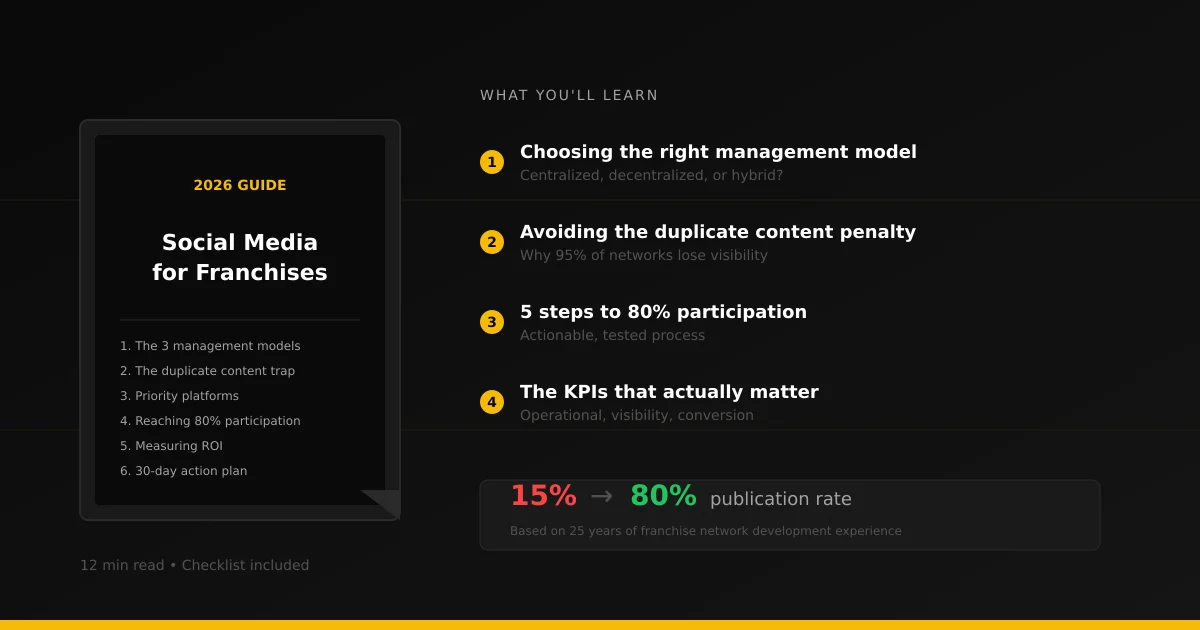
This playbook is designed for marketing directors of networks with 50 to 500 locations. No HR theory. Concrete actions, defined roles, measurable KPIs. The goal: go from 15% to 80% participation rate in 6 months.
Franchise vs traditional company: why employee advocacy is different
In a traditional company, employees are salaried staff. The hierarchy is clear. The EA program is deployed through HR and internal communications.
In franchising, none of that works.
Multi-location and shared governance
Franchisees are not employees. They are independent business owners. You cannot mandate that they publish. You have to convince them. Each location has its own constraints, its own team, its own relationship with social media.
Brand identity vs local authenticity
A standard EA program pushes corporate content. In franchising, content must feel local and authentic. An identical post published from 100 different stores convinces no one and penalizes your algorithmic reach.
Scale multiplies the problems
What works with 10 locations collapses at 100. Coordination becomes a project in itself. Without rigorous processes and the right tools, the program dies within a few weeks.
The 4 key roles of a franchise EA program
An employee advocacy program in franchising cannot rely on a single person. It requires four distinct roles with clear responsibilities.
| Role | Reports to | Key responsibilities | Time/week |
|---|---|---|---|
| HQ Content Manager | Marketing Director | Creates content, defines editorial guidelines, produces templates | 8-12h |
| Network Coordinator | Network Director | Coordinates deployment, trains franchisees, re-engages inactive ones | 4-6h |
| Franchisee | Independent | Approves, customizes, and schedules publications for their location | 30-45 min |
| Field team member | Franchisee | Publishes content from their personal profile (optional) | 10-15 min |
The HQ Content Manager: the source
This is the person who produces reference content. They work with the network’s editorial calendar and create posts optimized for each platform. Their key role: provide content that franchisees will want to publish. Not corporate press releases. Engaging, visual content rooted in everyday reality.
The Network Coordinator: the link
This role is often overlooked. Yet it is the most strategic. The network coordinator is the bridge between headquarters and the field. They identify the most engaged franchisees (the “champions”), support the reluctant ones, and feed field insights back to HQ. In high-performing franchise social strategies, this role makes the difference between 20% and 80% participation.
The Franchisee: the local decision-maker
The franchisee does not create content. They receive it, customize it if needed, and decide whether to publish it. Their engagement depends on three factors: simplicity of the process, relevance of the content, and visibility of results.
The Field team member: the amplifier
Optionally, the franchisee’s employees can also share content from their personal profiles. This is the next level of employee advocacy: organic reach skyrockets when it is no longer just business pages publishing, but individuals.
Content that works in franchising
EA content in franchising must solve an equation: stay true to the brand while appearing local and authentic. Here is what works.
Templates with variables
Automatic personalization is the key. HQ creates a template with dynamic variables that the tool automatically replaces for each location.
Template example:
Great news for {{city}}! Your {{store}} store is offering
[promotion] this week. Come visit us at {{address}}.
{{manager}} and the team are ready to welcome you!
Result for Chicago:
Great news for Chicago! Your Optique Martin Chicago store is offering
[promotion] this week. Come visit us at 120 Michigan Avenue.
Jean Martin and the team are ready to welcome you!
The HQ content / local content mix
An effective franchise EA program does not rely solely on HQ content. The ideal ratio:
- 60% HQ content: promotions, product launches, national campaigns
- 30% local content: store events, team highlights, behind the scenes, local anchoring
- 10% free content: the franchisee publishes what they want (within brand guidelines)
This mix ensures brand consistency while preserving the authenticity that makes local powerful. It is also what differentiates your strategy from simple Facebook page centralization.
Formats that drive engagement
In 2026, not all formats are created equal. For franchise employee advocacy:
- Short videos (Reels, Shorts, TikTok): best organic reach
- Carousels: high save and share rates
- Customer testimonials: ultra-effective local social proof
- Behind-the-scenes team content: humanizes the location
The duplicate content trap in franchising
This is the number one problem of network EA programs. And most marketing directors ignore it until it is too late.
The classic scenario
HQ creates a post. Sends it to 100 locations. The 30 most motivated franchisees publish it as-is. 30 identical publications appear on Facebook, Instagram, and LinkedIn on the same day.
The algorithmic impact
Social media algorithms detect duplicate content. Their response is systematic:
- Facebook: reach reduction of 40 to 70% on copies
- Instagram: visibility removed from the Explore tab
- LinkedIn: the post is flagged as spam beyond 5 identical copies
The result is paradoxical: the more your franchisees publish, the less visible they become. The EA program sabotages itself.
The solution: systematic variation
Each location must publish a unique version of the content. This is exactly what we detail in our Employee Advocacy LinkedIn guide: automatic rephrasing, local variables, staggered timing.
A tool like nPosts.ai automatically generates unique variations for each location. Same underlying message, different form. The algorithm treats each post as original content. Reach is preserved.
Measuring success: franchise-specific KPIs
A franchise EA program is not measured like a standard corporate program. KPIs must reflect the reality of the network: independent actors, varying engagement levels, distributed reach.
KPI dashboard
| KPI | Definition | M3 target | M6 target | M12 target |
|---|---|---|---|---|
| Participation rate | % of locations publishing at least 1x/week | 40% | 65% | 80% |
| Cumulative network reach | Sum of impressions across all locations | +50% vs baseline | +150% | +300% |
| Avg. engagement/location | Likes + comments + shares per location per month | 50 interactions | 120 interactions | 200 interactions |
| Avg. time to publish | Time between content delivery and publication | < 5 min | < 2 min | < 1 min |
| Customization rate | % of posts modified/customized by the franchisee | 20% | 35% | 50% |
| Platform coverage | Number of active platforms per location | 1.5 | 2 | 3 |
The 3 maturity levels
Level 1 — Launch (M1-M3): Focus on participation rate. If franchisees are not publishing, nothing else matters. Aim for quick wins: ready-to-publish content, minimal friction.
Level 2 — Growth (M3-M6): Participation rate stabilizes. Optimize quality: customization, format mix, timing. Start measuring engagement and reach.
Level 3 — Performance (M6-M12): The program is established. Shift to business KPIs: in-store traffic, conversions, ROI. Compare active vs inactive locations to prove impact.
Frequently asked questions
What is employee advocacy in franchising ?
Employee advocacy in franchising means turning franchisees and their field teams into brand ambassadors on social media. Unlike a traditional company, headquarters cannot mandate publishing. Instead, it must convince independent business owners by providing relevant, easy-to-use content.
How do you convince franchisees to post on social media ?
Three levers work: reduce friction (ready-to-publish content in one click), show concrete results (engagement, in-store traffic), and identify “champions” who inspire others. A tool like nPosts.ai delivers personalized content that franchisees can approve and publish with a single tap.
What participation rate should a franchise EA program target ?
A realistic goal is to go from 15% to 40% in 3 months, then 65% at 6 months and 80% at 12 months. The participation rate (percentage of locations publishing at least once per week) is the number one KPI for an employee advocacy program in a franchise network.
How do you avoid duplicate content in franchise employee advocacy ?
Duplicate content is the number one trap. If 30 franchisees publish the same post, algorithms reduce reach by 40 to 70%. The solution: generate unique variations for each location using local variables (city, manager name, address) and staggered publication timing.
What tool should you use to deploy employee advocacy in a franchise ?
A franchise-ready tool must handle multi-location content distribution, automatic per-location personalization, and anti-duplicate variation. nPosts.ai was built specifically for networks of 50 to 500 locations: one HQ post is transformed into hundreds of unique publications, each publishable with a single tap by the franchisee.
Conclusion
Deploying employee advocacy in a franchise network is a structural project. It is not a simple communications program. It is a shift in how content is distributed.
3 key takeaways:
- Roles must be clearly defined. Without a Content Manager, Network Coordinator, and a clear process for the franchisee, the program runs out of steam within weeks.
- Content must be customizable and anti-duplicate. Copy-paste kills reach. Every published post must be a unique version, tailored to the location.
- Franchise KPIs are not corporate KPIs. Network participation rate is your number one indicator. Everything else follows from it.
nPosts.ai was built to solve exactly this problem: transforming one HQ post into hundreds of unique, personalized publications that each franchisee can publish with a single tap. The EA program becomes a process, not a project. Discover how centralized franchise social media management makes this possible at scale.