When I took over an eyewear franchise in 2013, I noticed a stark reality: the 85% of locations that never posted on social media weren’t afraid of the tool — they were afraid of absurdity. Publishing the exact same post across 100 pages meant inviting every store manager to think, “This has nothing to do with my store, my customers, my local reality.”
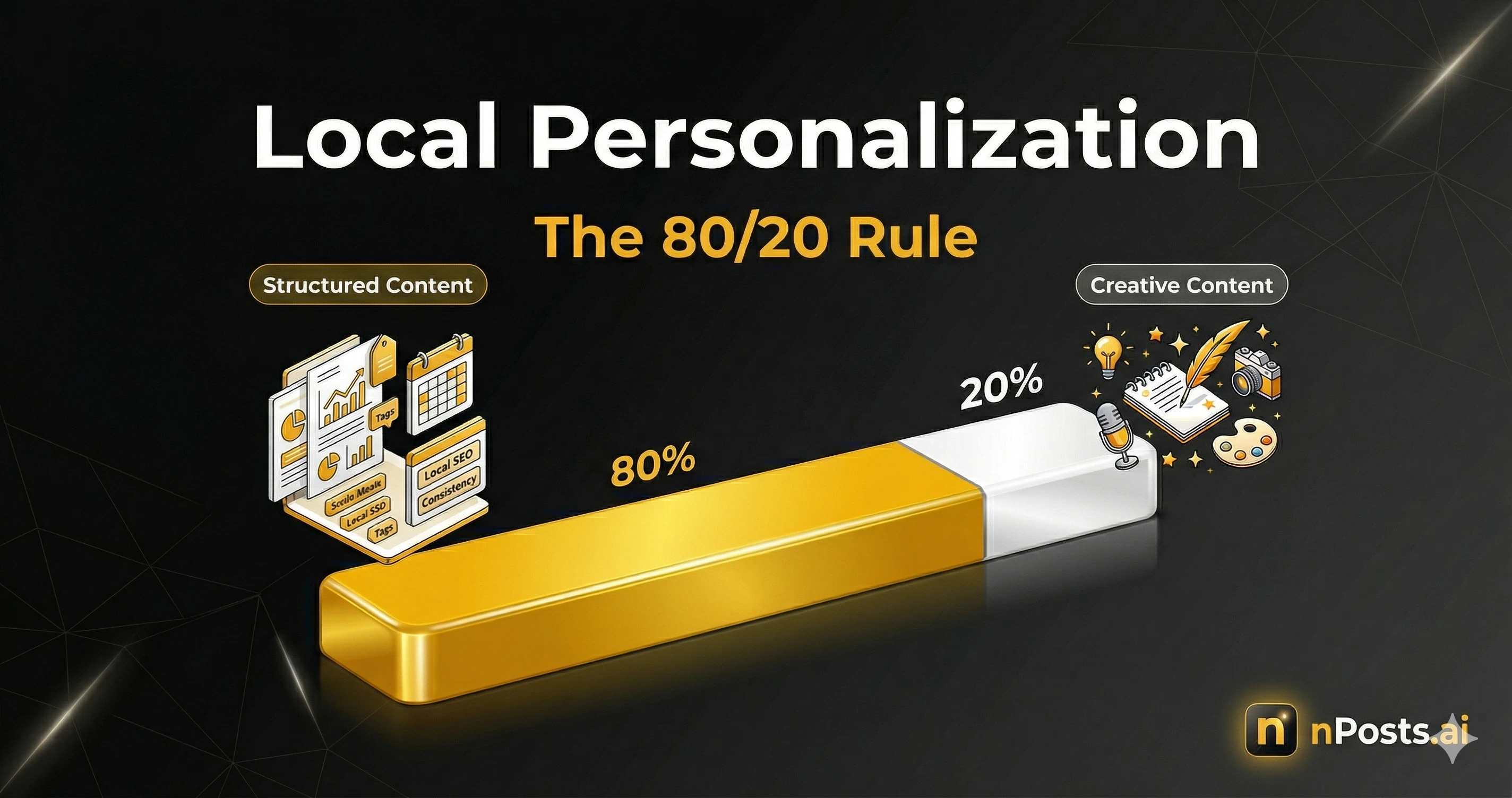
Ten years later, while building nPosts.ai, I understood the real mechanism: the best social content for a franchise is neither 100% centralized nor 100% chaotic — it’s 80% structured and 20% free.
This guide explains how to implement the 80/20 rule and transform your locations into credible ambassadors for your network, without diluting your brand.
The franchise paradox: being everywhere the same AND unique locally
The problem with total uniformity
Imagine this scenario. Head office creates a beautiful post: “Discover our new frames — 2026 trends!” with a stunning studio photo. It’s published simultaneously across all 100 franchise Facebook pages.
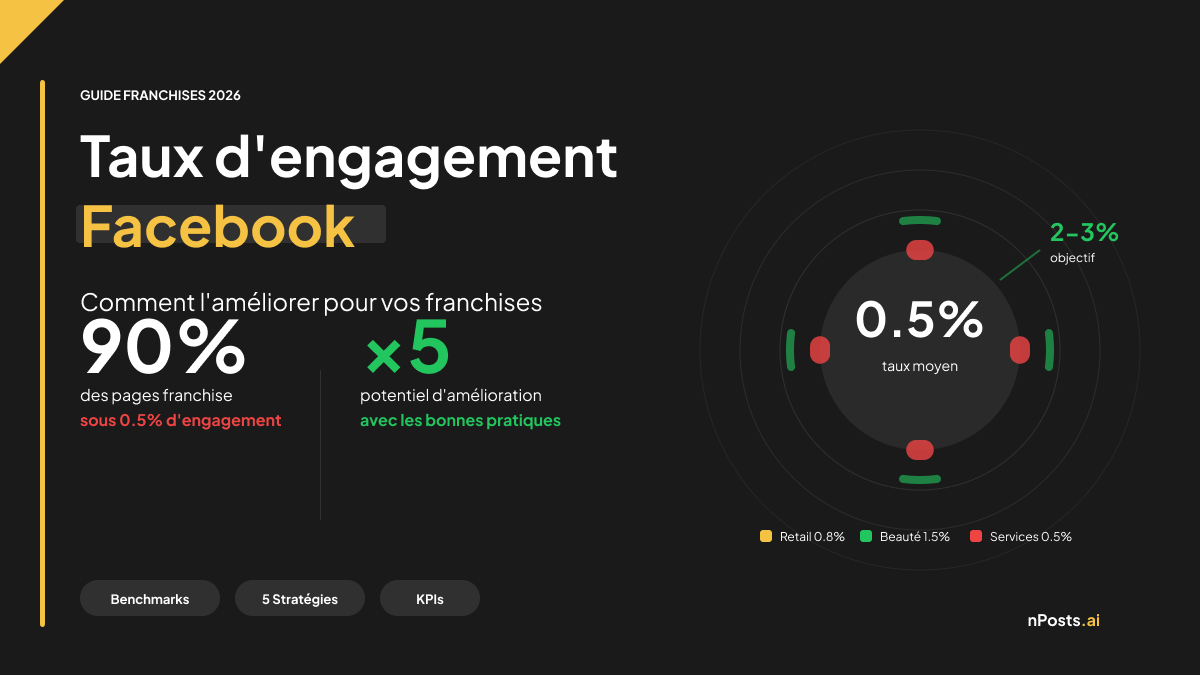
Result? Average engagement rate: 0.8%. Comments: a few founder’s friends liking out of solidarity. Local customers? Invisible.
Why? Because a corporate post doesn’t speak to anyone in particular. There’s no face, no recognizable store, no “this is for you” directed at the customer in Belleville Paris or downtown Nantes.
This is especially true in Western Europe where consumers value local authenticity. A local customer review, a photo of the store team, a neighborhood event — these pieces of content generate 3-4x more engagement than a generic message.
The danger of complete anarchy
Conversely, if you give 100 franchisees a blank check with no framework, here’s what happens:
- Franchisee A posts a blurry photo of their store with bad lighting
- Franchisee B launches an unauthorized promotion involving partner brands
- Franchisee C writes in a tone completely misaligned with the brand
- Franchisee D forgets the network hashtag and becomes invisible in the collective strategy
In 2 weeks, you no longer have one coherent brand — you have 100 different brands wearing the same logo.
The 80/20 rule: How to structure without choking
The 80/20 rule is simple: 80% of the content architecture is standardized, 20% is adaptable locally.
Here’s what that means concretely:
The 80%: What Must Be Standard
Network backbone content — mandatory, consistent across all locations:
-
Tone and voice — Define it once, apply everywhere
- Example: “We’re approachable, local, expert in our field. No corporate jargon.”
- Applied at every location, without exception
-
Campaign themes — The big ideas come from HQ
- Example: “January = Back to Work collection” or “Summer Trends 2026”
- All locations publish around the same themes, but adapted locally
-
Color, logo, fonts — Visual coherence is non-negotiable
- All social visuals follow the brand color palette
- Logo placement, sizing, positioning: standardized
- Typography hierarchy: consistent across posts
-
Hashtag system — One network hashtag + one location hashtag
- Example:
#MyFranchiseName(network) +#MyFranchiseParisEst(location) - Ensures collective visibility while marking locality
- Example:
-
Publishing frequency — Minimum floor per platform
- Example: 3 Facebook posts minimum per week, 4 Instagram posts per week
- No location can fall below this, though they can exceed it
-
Content types that always work — Proven formats replicated everywhere
- Customer testimonials (template: 60-second video)
- Team introductions (template: photo + 3-line bio)
- Local events (template: time, place, what to expect)
- Behind-the-scenes (template: a day at the store)
The 20%: What’s Freely Adaptable
Local flavor — where franchisees become creators:
-
Local events and partnerships
- The Belleville Paris location partners with a neighborhood association — they can highlight that
- The suburbs location sponsors a local sports team — exclusive content opportunity
- A manager’s personal passion (cooking, fitness, local history) — leverage it
-
Community-based stories
- “Meet your Belleville team” features the actual store manager by name and photo
- Local customer stories that matter to that community
- Neighborhood news relevant to that location only
-
Timing and frequency adjustments
- One location might publish 6 times per week because their audience is very active
- Another publishes 3 times because engagement patterns differ
- Both respect the minimum floor, but adapt above it
-
Format experiments
- One location tests TikTok before others — if it works, it becomes network 80%
- Another tries Instagram Reels with local music — if engagement is 5x higher, replicate
- Controlled innovation at the location level, then scale to network
-
Product and local relevance
- National product launch: core content is the same (80%)
- But each location can highlight how the product solves their neighborhood’s needs
- Summer collections angle: beach town location talks water sports; urban location talks commuting style
The 80/20 Implementation Framework
Step 1: Define Your 80% (Takes 1 Day)
Create a brand content manual with these sections:
| Section | Example | Owner |
|---|---|---|
| Brand Voice | ”Approachable expert, never condescending” | HQ Marketing |
| Visual Grid | Color palette, logo variations, photo style | HQ Design |
| Hashtag System | #MyFranchise + #MyFranchise[Location] | HQ Social |
| Minimum Posting Schedule | 3/week Facebook, 4/week Instagram | HQ Strategy |
| Campaign Calendar | Q1: New collection, Q2: Summer, etc. | HQ Marketing |
| Approved Content Templates | 10 post templates (testimonial, event, behind-the-scenes) | HQ + Templates |
This manual is your “don’t deviate” bible. It’s short (5-10 pages), visual, and non-negotiable.
Step 2: Empower the 20% (Give Them Tools)
Provide each location with:
-
A content ideas library — Pre-written prompts for local adaptation
- “This week’s campaign is Summer Trends. Your local angle: [write about why your neighborhood’s summer style is unique]”
- Location manager fills in 1-2 sentences about their community
-
Design templates with local fields
- HQ creates post templates with:
- Locked sections: brand colors, logo, standard text
- Open fields: location name, local photo, local story
- Manager uploads a photo, edits location name, publishes in minutes
- HQ creates post templates with:
-
A simple approval flow (if needed)
- For locations 1-10: maybe HQ reviews before posting
- For locations 11-100: review analytics after posting, not before
- This scales — you can’t review 100 posts per day
-
A monthly highlight system
- “Best local content this month wins…” (feature, recognition, or small incentive)
- Encourages creativity within the 20% without chaos
Concrete Example: How 80/20 Works in Practice
Let’s follow a campaign: “Spring Collection Launch”
The 80% (HQ controls)
- Campaign theme: “Refresh Your Look for Spring”
- Launch date: April 1, 2026
- Approved visuals: 3 professional photos of the spring collection (provided by HQ)
- Tone: “Light, approachable, trend-forward without being pretentious”
- Hashtags: #MyFranchiseSpringRefresh + #MyFranchise[Location]
- Minimum content: 3 posts across Facebook/Instagram over 2 weeks
The 20% (Location adapts)
Location: Belleville Paris
- Posts HQ photos + adds: “Our Belleville customers love bold colors — here’s spring’s most daring frames for the neighborhood that wears them best”
- Stories: Short videos of the actual Belleville team trying on spring frames
- Local angle: Mentions the neighborhood’s outdoor markets opening in spring, frames that match that vibe
Location: Suburban Shopping Center
- Same HQ photos + caption: “Fresh frames for the commute season — lighter, more comfortable for those longer workdays”
- Stories: Behind-the-scenes of the team refreshing the in-store displays
- Local angle: Highlights that this center gets a lot of young professionals
Location: Beach Town
- Same HQ photos + caption: “Spring means sun season here — discover frames that protect while looking fresh”
- Stories: Photo of the actual storefront with spring flowers in bloom (location asset)
- Local angle: Tie to beach tourism, vacation planning
Same campaign, three different stories. All on-brand. All locally credible.
Anti-Pattern: What NOT to Do
Don’t: Let locations ignore the 80%
❌ Bad: Location posts whenever they feel like it, ignoring the campaign calendar
- This breaks the network effect. No collective visibility.
✅ Good: Even if locations add 20% local flavor, they respect the 80% structure and timeline.
Don’t: Create templates so rigid there’s no room for adaptation
❌ Bad: HQ sends a complete post, locations literally copy-paste it word-for-word across 100 pages
- This is what kills engagement (we tested it, it’s 0.8% engagement rate)
✅ Good: HQ provides the structure and key message, locations fill in the local story.
Don’t: Leave the 20% completely unguided
❌ Bad: Tell locations “do whatever you want with 20%” and never review
- You end up with tone-deaf posts, brand violations, inconsistent quality
✅ Good: Monthly reviews, a highlight system, and gentle guidance on what works.
Don’t: Make the 80% so heavy that locations quit
❌ Bad: Locations perceive the guidelines as restrictive corporate control
- They stop posting, or worse, they circumvent the system
✅ Good: Position the 80% as empowering — “Here’s the proven framework. Now make it yours locally.”
Measuring the 80/20 Success
Once you’ve implemented the rule, track these metrics:
| Metric | Baseline | Target | Why |
|---|---|---|---|
| Publishing frequency | ~30% of locations publish 3x/week | 85%+ follow minimum schedule | Content is the start |
| Engagement rate | 0.8% (uniform posts) | 2.5-3.5% (personalized) | Local relevance drives engagement |
| Brand coherence score | Visual audit: 60% consistent | 90%+ consistent visuals | The 80% is working |
| Franchisee satisfaction | ”Content feels restrictive" | "Content feels empowering” | The 20% freedom matters |
| Locations adapting 20% | 10% customize content | 60%+ create local stories | Adoption = success |
The Bigger Picture: 80/20 Is More Than Content
The 80/20 principle extends beyond social media:
- Customer experience: 80% consistent standards (greeting, service time), 20% local adaptation (neighborhood culture, language nuances)
- Product: 80% network offerings, 20% local exclusive partnerships
- Operations: 80% standard processes, 20% location flexibility
But when it comes to social media, the 80/20 rule is the lever that unlocks franchisee participation. It says: “I trust you to represent our brand AND your community.”
And that’s when the magic happens. Engagement triples. Franchisees post regularly. The brand becomes visible in 100 neighborhoods instead of invisible in 1 HQ office.
Actionable Next Steps
- Week 1: Write down your non-negotiable brand elements (voice, visuals, hashtags, frequency) — this is your 80%
- Week 2: Create 5 content templates that location managers can adapt (testimonial, event, team, behind-the-scenes, promotion)
- Week 3: Launch a pilot with 5 locations — give them the templates, let them customize the 20%, measure engagement
- Week 4: Expand to all locations, train them on the 80/20 principle, set up a monthly review cadence
The locations that embrace this become your social ambassadors. The ones that feel empowered by structure, not strangled by it.
That’s the difference between 85% of locations never posting… and 85% posting consistently, locally, and authentically.
FAQ: The 80/20 Rule
”Won’t the 20% local variation create brand confusion?”
No — as long as the 80% is clear enough. Think of McDonald’s: identical operations (80%), but menu items and store vibe adapted to each country (20%). The brand is immediately recognizable.
Same with social. If your colors, tone, and hashtags are locked (80%), the 20% adaptation of story makes the brand stronger, not weaker.
”How do I know if something is 80% or 20%?”
Ask yourself: “Does this need to be the same across all locations for brand coherence?”
- Logo placement, color palette, tone → 80%
- Which customer story to highlight, which local event to feature → 20%
“Can the 20% vary by platform?”
Absolutely. TikTok might be 70/30 (more freedom to experiment, more local voice). Facebook might be 85/15 (more corporate, less adaptation). The principle is flexible; the discipline is not.
”What if a location violates the 80%?”
Don’t ban them. Review, give feedback, retrain. Violations usually come from misunderstanding, not malice. Clear communication fixes most issues.
”Is this system scalable to 500 locations?”
Yes. The 80/20 framework scales because it’s structured. You’re not managing 500 individual creativities — you’re managing one framework with 500 local expressions of it.
Request a demo of how nPosts.ai automates the 80/20 content distribution to all your locations in one click. Book your demo.