
Local Marketing for Franchises: The Scale Problem No One Talks About
72% of consumers search for a local business online before visiting in person. That statistic alone should stop any franchise marketing director in their tracks.
Because here is the reality: your brand may be nationally recognized, but what wins or loses a customer is what happens at the local level. The Google Business Profile that has no photos. The Facebook page that last posted six months ago. The review that went unanswered for three weeks. These are not hypothetical scenarios — they are happening right now across your network.
The challenge with franchise local marketing is not a lack of content or budget. It is a challenge of scale and coordination. A strategy that works brilliantly for one location becomes nearly unmanageable when you have 50, 100, or 300 locations operating under the same brand.
This guide breaks down exactly how franchise marketing teams build a local marketing engine that scales — covering the five core pillars, deployment frameworks, the right tools, and a practical checklist to get every location performing consistently. Whether you manage 20 locations or 500, the principles are the same.
Why Local Marketing Is Essential for Franchises
National vs. Local: Two Different Games
National marketing builds brand awareness. It creates the mental shortcut that makes a consumer recognize your logo and trust your product. But it does not convert browsers into foot traffic at a specific location on a Tuesday afternoon.
Local marketing operates at a completely different level of intent. When a consumer searches “best sandwich near me” or “oil change open now,” they are ready to make a decision. They are not browsing — they are choosing. That moment of intent is where local marketing wins or loses customers.
For a franchise, the implications are significant. The parent brand can invest millions in national campaigns, but if the individual location has an incomplete Google Business Profile, a dormant social media presence, and no recent reviews, it will lose that ready-to-buy customer to a local independent competitor who has done the basics right.
The Numbers Behind Local Intent
The evidence is consistent across multiple research sources:
| Metric | Data |
|---|---|
| Consumers who search locally before visiting | 72% |
| Local searches that result in a store visit within 24h | 76% |
| Mobile local searches converting to offline purchases | 78% |
| Increase in visits from a complete GBP vs. incomplete | 70% |
| Revenue uplift from active local social presence | 23% avg. |
“Near me” searches have grown by over 500% in the past five years. For franchise networks, each one of those searches is an opportunity — but only if the local presence is built to capture it.
The Franchise-Specific Multiplier Effect
Here is what makes local marketing both essential and complex for franchise networks: every location is a separate local marketing entity. Each has its own:
- Google Business Profile (or should)
- Facebook and Instagram page
- Local review profile
- Geo-specific audience
A network of 100 locations is not one local marketing challenge. It is 100 parallel local marketing challenges that need to be coordinated from a central point without losing local authenticity. That tension — between brand consistency and local relevance — is what this guide is designed to resolve.
The 5 Pillars of Franchise Local Marketing
A solid franchise local marketing strategy rests on five interconnected pillars. Weakness in any one of them creates gaps that competitors will fill.
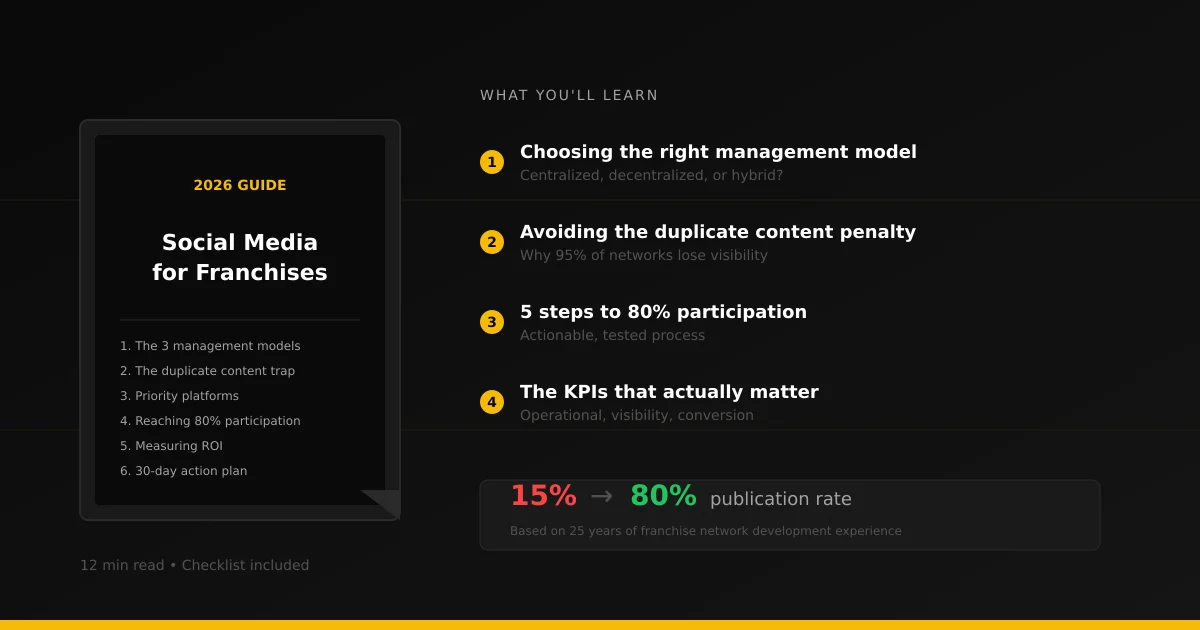
For a broader overview of how these pillars connect to your social media strategy, see our complete guide to franchise social media strategy.
Google Business Profile
Google Business Profile (GBP) is the single most impactful local marketing asset for any brick-and-mortar franchise location. It is the information panel that appears when someone searches for your brand or your category in their area. It drives calls, directions requests, and website visits directly from the search results page.
A complete, actively managed GBP listing for each location should include:
- Accurate NAP data — Name, Address, Phone number, consistent with every other directory
- Business hours — Updated for holidays and special events
- Photos — Minimum 10 photos per location: exterior, interior, team, products
- Google Posts — Weekly posts announcing promotions, events, or news
- Q&A section — Pre-populated with the most common questions
- Review responses — Every review, positive or negative, acknowledged within 48 hours
The difference in performance between an optimized GBP and a bare-minimum listing is dramatic. Profiles with more than 100 photos receive 520% more calls than those with none. For a 100-location network, that gap in performance is hundreds of missed calls per week.
The operational challenge for franchises is maintaining this standard across every location, not just the flagship stores. A centralized publishing tool that can push GBP posts and updates to all locations simultaneously is not a luxury at this scale — it is a necessity.
Local Social Media
Facebook and Instagram pages per location are the social layer of local marketing. They serve a different function than the brand’s national accounts: they communicate proximity, personality, and community belonging.
A customer who follows their local franchise location on Instagram is more engaged, more loyal, and more likely to generate word-of-mouth than a customer who follows only the national brand page. The local page creates a relationship that the national page simply cannot replicate.
For franchise networks, the operational model matters enormously here. There are three options:
- HQ-managed: Headquarters publishes to all location pages directly. Consistent, but impersonal.
- Franchisee-managed: Each franchisee manages their own pages. Local, but inconsistent.
- Hybrid model: HQ provides a content base that franchisees can personalize before publishing. The optimal approach.
The hybrid model consistently produces the best results. It combines brand consistency with local relevance, and it dramatically increases franchisee participation because the effort barrier is low. Franchisees receive ready-to-publish content that they can optionally adapt rather than starting from a blank page.
Local SEO
Local SEO extends beyond Google Business Profile. It encompasses the entire digital footprint of each location in local search results, including:
NAP consistency: The business name, address, and phone number must be identical across every directory where the location is listed — Google, Bing, Apple Maps, Yelp, Facebook, TripAdvisor, and dozens of industry-specific directories. Inconsistencies between listings confuse search engines and suppress local rankings.
Local citations: Listings in relevant local and industry directories build the authority signals that Google uses to rank local businesses. For a franchise, managing citations at scale — creating, correcting, and updating them across all locations — requires a systematic approach.
Location-specific landing pages: Each location should have a dedicated page on the brand website with its own unique content, not a template with only the address swapped out. Search engines penalize thin, duplicated location pages.
Local backlinks: Coverage in local news outlets, community blogs, and local business associations builds location-specific authority. HQ can support this by providing press kits and story angles that franchisees can use to generate local coverage.
Customer Review Management
Online reviews are a direct ranking factor in local search and a primary trust signal for consumers. 93% of consumers say online reviews influence their purchasing decisions. For franchise networks, review management has two components that must both be active.
Review generation: Most satisfied customers do not leave reviews without being asked. A systematic post-visit review request — via email, SMS, or receipt QR code — can increase review volume by 300-400%. More reviews, more recent reviews, and a higher average rating all improve local rankings and consumer trust.
Review response: Every review requires a response, and that response must be timely, professional, and genuinely addressed to the specific customer. Generic, copy-pasted responses are visible to every potential customer who reads the review thread. They signal that the brand does not actually care.
At scale, review management requires either dedicated local staff or a centralized monitoring system that flags reviews requiring responses and provides response guidance or templates. The goal is ensuring no review goes unanswered for more than 48 hours across any location in the network.
Geo-Targeted Advertising
Paid local advertising amplifies the organic local presence for specific objectives: new location launches, seasonal promotions, competitive displacement, or driving traffic during slow periods.
The two primary channels are:
Google Local Campaigns: Geo-targeted search and display campaigns that reach consumers actively searching in a specific radius around a location. These campaigns can be coordinated at the network level with location-specific assets and offer the strongest intent targeting available.
Facebook and Instagram Local Ads: Radius-based social advertising allows precise geo-targeting around each location. Campaigns can promote location-specific offers while maintaining brand creative standards. The franchise model benefits from a cooperative advertising fund structure where HQ manages campaign templates and franchisees activate them locally.
Effective paid local advertising requires alignment between the ad creative, the landing page (often the GBP or location website page), and the in-store experience. A disconnect anywhere in that chain reduces conversion rates and wastes budget.
How to Deploy a Local Marketing Strategy Across 100+ Locations
Centralized vs. Decentralized: Choosing Your Model
Most franchise networks start at one of two extremes and eventually migrate toward the middle. Pure centralization produces consistency but lacks local relevance and often fails to engage franchisees. Pure decentralization produces local authenticity but brand chaos and wildly uneven execution quality.
The research is clear: the hybrid model — centralized content creation with local activation — consistently outperforms both extremes on reach, engagement, and franchisee participation rates.
The key principle is to reduce friction for franchisees without removing their agency. When franchisees feel like recipients of mandates rather than partners in execution, participation collapses. When they feel genuinely supported with tools and content that makes their job easier, participation scales.
Roles: HQ vs. Franchisee
A clear division of responsibility is the operational foundation of any franchise local marketing deployment.
| Task | HQ Responsibility | Franchisee Responsibility |
|---|---|---|
| Brand guidelines and visual standards | Define and enforce | Respect and apply |
| Content creation (national campaigns) | Create and distribute | Publish (with optional local adaptation) |
| Google Business Profile setup | Create and verify initial listing | Update with local hours, photos, events |
| Social media content calendar | Produce weekly content base | Add local context, activate |
| Review monitoring | Provide tools and escalation support | Respond to all reviews within 48h |
| Paid advertising templates | Create campaigns and creative | Activate and fund local campaigns |
| Performance reporting | Aggregate network metrics | Report local data |
| Local photography | Provide guidelines and resources | Shoot and submit location-specific content |
Deployment Checklist Per Location
When onboarding a new location or auditing an existing one, work through this deployment checklist:
Digital presence setup
- Google Business Profile claimed, verified, and fully completed
- Facebook Business Page created under brand Business Manager
- Instagram account created and linked to Facebook
- NAP verified consistent across Google, Bing, Apple Maps, Yelp
- Location page live on brand website with unique local content
Content infrastructure
- Franchisee has access to content management platform
- Social media content calendar shared and understood
- Brand asset library accessible (logos, templates, photography)
- Review monitoring tool configured with location
Launch baseline
- 10+ photos uploaded to GBP
- First Google Post published
- First social media posts published on Facebook and Instagram
- Review generation process activated (email/SMS sequence)
Local Marketing Tools for Franchises
The Tool Stack Problem
The franchise local marketing tool landscape is fragmented. A network relying on separate platforms for social media publishing, GBP management, review monitoring, and analytics is paying for redundancy while creating coordination gaps. The operational overhead of managing multiple disconnected tools scales poorly as the network grows.
The ideal tool architecture for a franchise local marketing operation consolidates as much of the workflow as possible without forcing the use of one tool for tasks it does not do well.
nPosts.ai: Multi-Location Publishing Without Duplication
The core publishing workflow — creating content at HQ and deploying it across all location pages simultaneously — is where nPosts.ai is purpose-built for franchise networks.
The critical differentiation is the anti-duplication engine. When identical content is published to 100 Facebook pages simultaneously, search algorithms detect it as duplicated content and suppress reach. nPosts.ai automatically generates local variations of each post, ensuring that the content reaching each location’s audience is unique while remaining brand-consistent. The result is that each location’s pages function like genuinely local accounts rather than cloned brand channels.
For a network of 100 locations, this means:
- One content creation cycle produces 100 unique, locally-adapted posts
- HQ maintains full brand control over messaging and creative standards
- Franchisees can optionally add local context before final publication
- All location pages remain active without requiring 100 separate publishing actions
This is the operational difference between a franchise network with a 15% publication rate and one with an 80%+ publication rate.
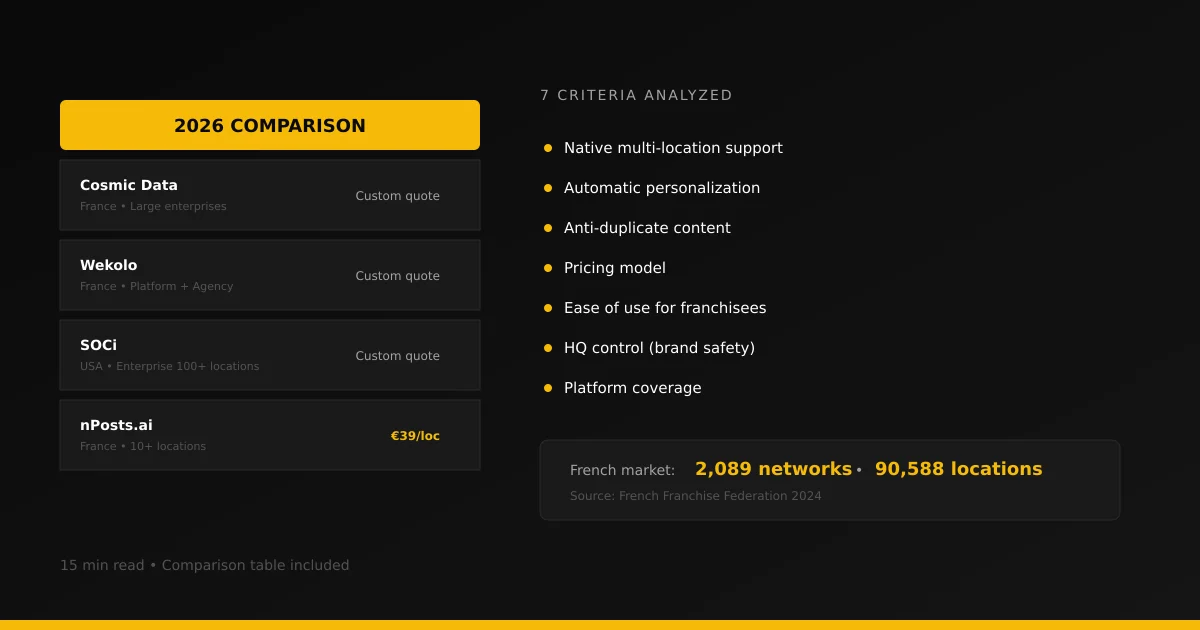
For a detailed comparison of tools available for franchise social media management, see our franchise social media tools comparison.
Other Tool Categories
Review management: Platforms like Birdeye, Podium, or Reputation.com aggregate reviews across platforms and locations, enable bulk response workflows, and automate review request sequences. Essential for networks with more than 20 locations.
Local SEO and citation management: Tools like Yext, Moz Local, or BrightLocal manage NAP consistency across directories at scale. They identify conflicting citations, push updates across listings simultaneously, and monitor local ranking positions per location.
Analytics: Google Analytics 4 with location-specific property configurations, combined with GBP Insights exported at the network level, provides the baseline performance data needed to identify which locations are excelling and which need support.
Case Studies: ROI of Franchise Local Marketing
Retail Network: +35% In-Store Traffic in 6 Months
A 78-location specialty retail franchise in France was experiencing a significant performance gap between its top-performing stores (20% of locations generating 60% of total in-store traffic) and the rest of the network.
An audit revealed the root cause: the high-performing locations had active, well-managed local digital presences. Complete GBP profiles, weekly social media posts, consistent review responses. The underperforming locations had either incomplete profiles, inactive social pages, or both.
The marketing team implemented a centralized local marketing program: GBP profiles were completed and verified across all 78 locations within 30 days. A weekly content calendar was deployed through a centralized publishing platform, with anti-duplication active to maintain organic reach. A review monitoring dashboard gave each franchisee visibility into their own rating and a simple response workflow.
At the six-month mark:
- Average in-store traffic across the network was up +35%
- GBP profile views increased by +280% across all locations
- Average network rating moved from 3.9 to 4.4 stars
- The performance gap between top and bottom quartile locations narrowed by 40%
The critical insight from this case: the upside was not from improving already-performing locations. It came entirely from raising the floor for the underperforming majority.
Restaurant Network: From 20% to 85% Publication Rate
A 140-location quick-service restaurant network had a social media problem that its marketing director described accurately: “We create great content. Nobody uses it.”
A franchisee survey found the issue was not motivation — it was friction. Franchisees cited lack of time, uncertainty about what they were allowed to post, and technical difficulties accessing the brand’s content library as the primary barriers. The publication rate across all location social pages was stuck at 20%.
The solution was not more content creation. It was removing the friction. The marketing team deployed a centralized publishing platform where HQ pre-loaded weekly content that franchisees could publish with a single approval action. Franchisees who wanted to customize posts could do so before publishing; those who did not could approve the default version in under 30 seconds.
Results over three months:
- Publication rate across all location pages went from 20% to 85%
- Average posts per location per month increased from 1.2 to 4.8
- Organic reach across the network increased by +320%
- Franchisee net promoter score for marketing support increased by 28 points
The lesson: franchisee participation is a product design problem, not a motivation problem. When the path of least resistance leads to publishing rather than ignoring, franchisees publish.
Franchise Local Marketing Checklist 2026
Use this checklist to audit your current local marketing performance and prioritize your next 90 days of activity.
Setup (One-Time Foundation)
- All location Google Business Profiles claimed, verified, and fully completed
- All location Facebook and Instagram pages created under HQ Business Manager
- NAP consistency verified across Google, Bing, Apple Maps, Yelp, and top industry directories
- Location-specific pages live on brand website with unique content per location
- Centralized social media publishing platform deployed and franchisees onboarded
- Review monitoring tool configured for all locations
- Brand asset library accessible to all franchisees
- Local ad campaign templates built and ready for franchisee activation
Weekly
- Weekly social media content batch created, localized variants generated, and scheduled across all location pages
- Google Posts published to all active GBP profiles
- New reviews flagged, responded to within 48 hours across all locations
- Any flagged GBP issues (incorrect hours, missing photos) corrected
- Local paid campaigns checked for budget pacing and performance
Monthly
- Network-level performance report: GBP views, social engagement, review ratings by location
- Bottom-quartile locations identified and contacted with specific support
- Review generation metrics reviewed — response rate, new review volume, average rating trajectory
- Citation audit: check for new inconsistencies across major directories
- Competitive local landscape check: which competitors are gaining visibility and how
- Franchisee feedback collected on content relevance and tool usability
- Local ad creative refreshed to avoid audience fatigue
TikTok and Local Marketing: A Powerful Combination
Social media is a core component of local marketing. In 2026, TikTok has emerged as the most effective local discovery tool thanks to its geolocation algorithm. To understand how to integrate it into your local strategy, see our guide on TikTok for local business marketing.
Conclusion: The Local Presence Gap Is a Revenue Gap
The franchise networks that will dominate local search in 2026 are the ones treating local marketing as operational infrastructure rather than a marketing optional. Every location with an incomplete GBP profile, a dormant social page, or unanswered reviews is an active revenue leak — not a missed opportunity, but a customer who found a competitor instead.
The good news is that the gap between average franchise local marketing performance and excellent performance is almost entirely an execution gap, not a strategy gap. The playbook works. The challenge is deploying it consistently across every location at the same time.
If your network is ready to close the local presence gap across all locations simultaneously, start with a Ghost Network Audit — a free analysis of your network’s current local presence performance, location by location, with a clear picture of where the revenue is being left on the table.
Want to see what consistent local marketing at scale looks like in practice? Request a demo of nPosts.ai and we will walk through your network’s specific situation.