Introduction
Managing social media for a franchise is not 50 times the work of managing a single account. It is a fundamentally different problem.
A single-location brand worries about content quality, posting frequency, and engagement. A franchise network with 50, 100, or 300 locations faces an entirely different set of challenges: coordination across dozens of stakeholders, brand consistency at scale, algorithmic penalties from duplicate content, and the uncomfortable reality that 85% of headquarters content never gets published by franchisees.
This guide provides a complete, step-by-step operational framework. Whether you manage 20 locations or 500, you will walk away with a concrete action plan to transform your network’s social media presence and reach 80% publication rate across your franchise locations.
No theory. No fluff. Seven actionable steps.
The Multi-Location Social Media Challenge
Before jumping into solutions, it is critical to understand why managing social media for multiple franchise locations is so difficult. Most networks fail not because of bad content, but because of a broken distribution model.
Why standard approaches fail at scale
The typical approach looks like this: headquarters creates a polished social media post, emails it to 100 franchisees, and hopes for the best.
Here is what actually happens:
HQ creates post -> Emails PDF/ZIP -> Franchisee inbox (buried in 80+ daily emails) -> ... -> Nothing
The franchisee has a store to run, customers to serve, and inventory to manage. Downloading a file, copy-pasting text, logging into Facebook, and formatting a post takes 15 minutes per post. Multiply that by 3 posts per week and you are asking a business owner for nearly an hour of social media work alongside everything else.
This is why the average publication rate for headquarters content distributed via email is only 10-15%.
But the problem goes deeper. Even when franchisees do publish, they often copy-paste the exact same text. When 100 Facebook pages publish identical content, Meta’s algorithm detects the duplication and reduces organic reach by up to 80%. Your franchisees did the work, but the algorithm punished them anyway.
One community manager cannot manage 100 local pages effectively. The content quality drops, local relevance disappears, and the audience disengages.
The 3 models of franchise social media
Every franchise network falls into one of three management models. Understanding which one you use today and which one you should use is the first strategic decision.
Model 1: Centralized
Headquarters creates and publishes all content directly to every local page. Brand consistency is perfect, but content is generic. There is zero local personalization. The workload on the marketing team is enormous, and engagement suffers because a post about “our nationwide promotion” does not resonate with a local audience in Denver.
Best for: Networks under 10 locations or highly regulated industries where every word must be legally approved.
Model 2: Decentralized
Each franchisee manages their own social media entirely. Some will be excellent, posting local events, team photos, and customer stories. Most will post nothing. A few will post content that damages the brand. You have no visibility, no control, and no consistency.
Best for: Almost no one. The risk far outweighs the benefit.
Model 3: Hybrid (recommended)
Headquarters creates the content. The franchisee receives it, personalizes it if needed, and publishes with a single action. This model combines brand consistency with local authenticity. It is the model used by the highest-performing franchise networks, and it is the foundation of this entire guide.
Best for: The vast majority of franchise networks, from 20 to 500+ locations.
Deep dive: the complete franchise social media management guide
Step 1: Audit Your Current Social Media Presence
You cannot improve what you do not measure. Before changing anything, you need a clear picture of where you stand.
Inventory all local pages
Create a spreadsheet listing every social media presence for every location:
| Location | Facebook Page | Google Business Profile | Status | |
|---|---|---|---|---|
| Store #1 - Chicago | fb.com/store1chicago | @store1chi | Claimed | Active |
| Store #2 - Miami | fb.com/store2miami | None | Unclaimed | Inactive |
| Store #3 - Denver | None | @denver_store3 | Claimed | Orphaned |
You will likely discover:
- Orphaned pages created by former franchisees or customers, with no admin access
- Duplicate pages for the same location (one official, one created by Facebook automatically)
- Missing profiles where a location has no presence at all
- Inconsistent branding with different logos, cover photos, and descriptions
Measure your current publication rate
For each location, track how many posts were published in the last 30 days. Then calculate:
Publication rate = (Locations that published at least 1x this month / Total locations) x 100
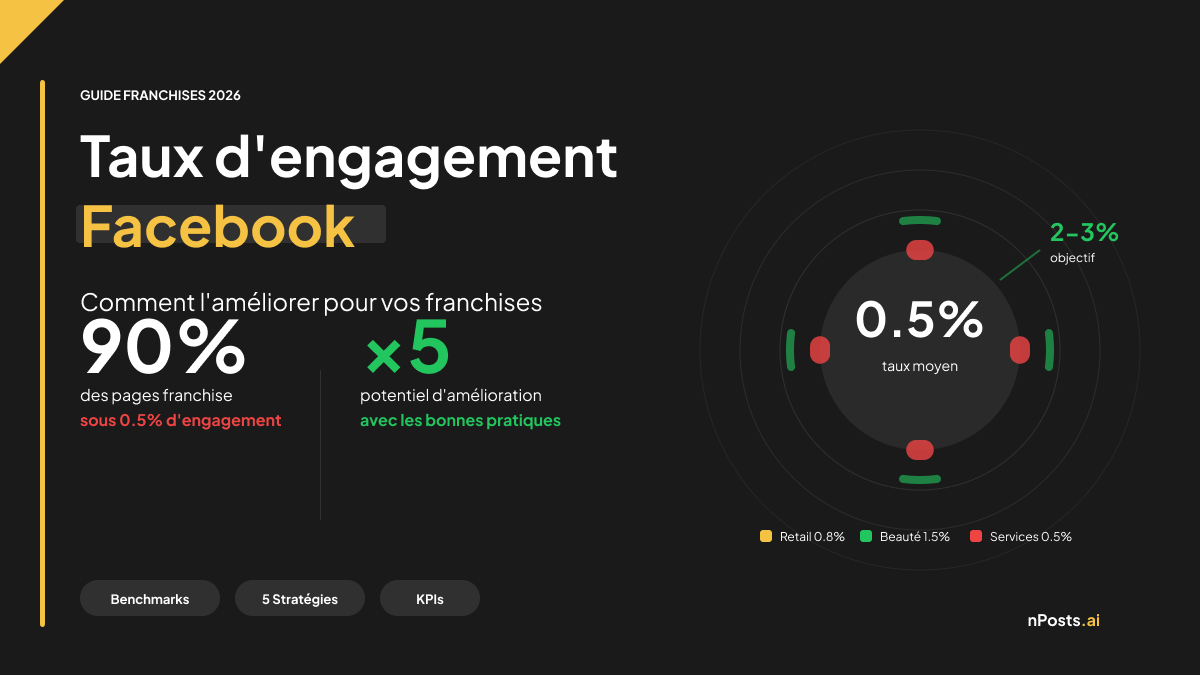
If your rate is below 20%, you are in the majority. The average franchise network publishes headquarters content at a rate of only 10-15%.
Assess content quality and consistency
Review a sample of 20 local pages. Check for:
- Brand-compliant cover photos and profile pictures
- Accurate business information (hours, address, phone)
- Content freshness (last post date)
- Engagement levels (likes, comments, shares per post)
- Tone and messaging consistency
This audit gives you your baseline. Every improvement from here is measurable.
Step 2: Define Your Content Strategy
A franchise content strategy is not a single editorial calendar. It is a two-tier system: headquarters content that ensures consistency, and local content that drives authenticity.
Headquarters content (70-80% of posts)
This is the backbone of your social media presence. Headquarters creates it, and it goes out across all locations.
Types of headquarters content:
- National brand campaigns and seasonal promotions
- Product launches and service announcements
- Educational content about your industry
- Customer testimonials and success stories
- Brand values and company culture
The key to scalability: templates with dynamic variables.
Instead of creating a fixed post, headquarters creates a template:
Discover our new spring collection at {{store_name}} in {{city}}!
Stop by {{address}} this weekend for an exclusive preview.
When published, each location automatically gets a personalized version:
- Store #1: “Discover our new spring collection at Martin Optical Chicago! Stop by 123 Michigan Ave this weekend…”
- Store #2: “Discover our new spring collection at Martin Optical Miami! Stop by 456 Ocean Drive this weekend…”
Same campaign. Unique content for every location.
Local content (20-30% of posts)
This is where franchisees add their personal touch:
- Team introductions and behind-the-scenes moments
- Local events: sponsorships, community involvement, local holidays
- User-generated content (UGC): customer photos, reviews, testimonials
- Store-specific news: renovations, new hires, anniversary celebrations
Local content consistently outperforms headquarters content in engagement because it feels authentic. The challenge is making it easy for franchisees to create and submit. For a broader view of how local content fits into a network strategy, our guide on local marketing for franchise networks provides a practical framework.
Step 3: Choose the Right Distribution Model
You have decided on a hybrid model. Now you need to define exactly how content flows from headquarters to local pages. There are three sub-models, and your choice will determine your success.
Automatic publishing
Headquarters publishes directly to all local pages without any franchisee involvement.
How it works: Content is created at HQ, scheduled, and pushed to every connected Facebook page, Instagram account, and Google Business Profile simultaneously.
Advantages:
- 100% publication rate guaranteed
- No franchisee training needed
- Complete brand consistency
Risks:
- No local personalization beyond dynamic variables
- Franchisees feel disconnected from their own social presence
- Can feel inauthentic to local followers
Best for: Urgent communications, crisis management, or networks where franchisees have explicitly opted out of social media involvement.
Suggested mode (recommended)
Headquarters creates and sends content. The franchisee receives a push notification, previews the personalized post, and publishes with a single tap.
How it works:
HQ creates post -> Push notification to franchisee -> Preview on phone -> 1 tap -> Published
Time required from franchisee: 40 seconds.
Advantages:
- Franchisees maintain ownership of their pages
- Brand consistency is preserved
- Local modifications are possible (add a comment, adjust timing)
- Publication rate reaches 80%+
Risks:
- Requires franchisee buy-in (though the simplicity sells itself)
- Some locations may still not publish
Best for: The vast majority of franchise networks. This is the model that delivers the best balance between control and autonomy.
Participative mode
Franchisees can propose their own content, which headquarters reviews and approves before publication.
How it works: The franchisee creates a post from their phone, submits it for review. Headquarters approves, edits, or rejects. Approved content is published.
Advantages:
- Encourages franchisee engagement
- Captures genuine local content
- Headquarters maintains quality control
Risks:
- Requires HQ resources to review submissions
- Slower publication cycle
Best for: Networks with engaged franchisees who want to contribute original content alongside headquarters campaigns.
The most effective networks use a combination: suggested mode for headquarters campaigns (the 70-80%), participative mode for local content (the 20-30%), and automatic publishing for critical announcements.
Step 4: Solve the Duplicate Content Problem
This is the step most franchise networks skip, and it is the one that costs them the most in organic visibility.
Why identical posts across 100 pages destroy your reach
When your 100 franchise locations publish the same text with the same image at roughly the same time, here is what Meta’s algorithm sees:
Page A (Chicago): "Spring sale! 30% off all frames this weekend only!" + [photo.jpg]
Page B (Miami): "Spring sale! 30% off all frames this weekend only!" + [photo.jpg]
Page C (Denver): "Spring sale! 30% off all frames this weekend only!" + [photo.jpg]
... x 100 pages
Meta’s 2026 algorithm update explicitly states that it “limits the reach of non-original content” and penalizes repetitive publications. Instagram applies the same policy.
The result: the algorithm picks ONE page to show (usually the one with the most followers) and suppresses the other 99. Your Chicago page is now competing against your own Miami page, and both are losing.
Full analysis: how duplicate content kills franchise visibility
Solutions to eliminate duplicate content
Solution 1: Dynamic variables
The minimum viable approach. Replace generic text with location-specific information:
{{store_name}}inserts the franchisee’s business name{{city}}inserts the city{{address}}inserts the street address{{manager_name}}inserts the store manager’s name
This helps but is not enough. The core text is still identical.
Solution 2: Hook, body, and CTA rotation
Create multiple versions of each element:
- 3 different opening hooks
- 3 different body paragraphs
- 3 different calls-to-action
Each location gets a random combination. With 3 hooks x 3 bodies x 3 CTAs, you already have 27 unique variations.
Solution 3: Automated anti-duplicate technology
This is where specialized franchise tools earn their value. nPosts.ai’s patented anti-duplicate engine automatically generates 2,916 unique combinations per campaign (9 hooks x 9 bodies x 9 CTAs x 4 angles). Each franchise location publishes a genuinely unique post while delivering the same brand message.
No manual work. No copy-paste. No algorithmic penalty.
Step 5: Set Up Your Tech Stack
Why a specialized franchise tool is necessary
Generic social media tools (Hootsuite, Buffer, Sprout Social) were built for community managers handling a handful of accounts. They fail at franchise scale for three reasons:
- Pricing model: per-user billing makes it prohibitively expensive for 100+ franchisees
- No anti-duplicate: they publish the same content everywhere
- Wrong workflow: designed for experts, not for busy store owners
A social media management platform for franchises needs to be purpose-built for multi-location distribution.
Criteria for choosing your tool
| Criterion | What to look for |
|---|---|
| Multi-location architecture | Manage 100+ pages from one dashboard, not 100 separate accounts |
| Anti-duplicate content | Automatic variation generation to protect organic reach |
| Franchisee simplicity | Publication in under 60 seconds from a mobile phone |
| Dynamic personalization | Automatic injection of store name, city, address |
| Approval workflows | Suggested mode, automatic mode, and participative mode |
| Pricing transparency | Per-location billing, not per-user |
| Platform coverage | Facebook, Instagram, Google Business Profile at minimum |
Quick comparison of franchise social media tools
| Tool | Best for | Anti-duplicate | Pricing |
|---|---|---|---|
| nPosts.ai | 10+ locations, hybrid model | Patented (2,916 variations) | From €59/location/month |
| SOCi | Enterprise 300+ locations | Not specified | Quote only ($$$$) |
| Cosmic Data | Large European brands | Not specified | Quote only |
| Wekolo | Networks wanting agency + tool | Not specified | Quote only |
Step 6: Onboard Your Franchisees
You have the strategy, the content plan, and the tool. Now comes the hardest part: getting your franchisees to actually use it.
The adoption challenge
Franchisees are not digital marketers. They are business owners who wake up every day focused on sales, staff, and operations. They have seen tools come and go. They have been promised “this will be easy” before.
Common objections:
- “I don’t have time for social media”
- “I’m not good with technology”
- “My customers don’t use Facebook”
- “The last tool was too complicated”
Training is not the answer. Simplicity is the answer.
Best practices for franchisee onboarding
1. Start with a pilot group of 10 locations
Do not roll out to 200 locations at once. Choose 10 stores with a mix of:
- Tech-savvy franchisees (early adopters)
- Average franchisees (the mainstream)
- Resistant franchisees (the skeptics)
If you can get the skeptics on board, you can get anyone.
2. Run the pilot for 30 days
During the pilot, track:
- Publication rate per store
- Time from notification to publication
- Franchisee feedback and friction points
- Engagement and reach metrics
3. Present pilot results to the full network
Nothing convinces a franchisee like peer results. When Store #7 in Tampa shows a 300% increase in local reach with 40 seconds of effort per post, the rest of the network pays attention.
4. Make mobile the default
Your franchisees live on their phones. Any tool that requires a desktop computer has already lost. The entire workflow must work on a smartphone:
- Receive push notification
- Preview the personalized post
- Tap to publish
If it takes more than 60 seconds, you will lose them.
5. Gamify participation (optional but effective)
Some networks successfully use leaderboards:
- “Top 10 most active stores this month”
- “Best engagement rate this quarter”
- Monthly recognition for consistent publishers
Competition drives action. Visibility drives pride.
How employee advocacy principles apply to franchise networks
Step 7: Measure and Optimize
Launching is not the finish line. It is the starting point. Continuous measurement and optimization is what separates networks that reach 80% publication rate from those that plateau at 40%.
KPIs to track
Operational KPIs (track weekly)
| KPI | Target | Why it matters |
|---|---|---|
| Publication rate | 80%+ | If franchisees are not publishing, nothing else matters |
| Time to publish | < 60 seconds | Measures friction in the process |
| Content per location/week | 3-5 posts | Consistency keeps the algorithm happy |
| Notification-to-action rate | > 70% | Shows franchisee engagement with the system |
Visibility KPIs (track monthly)
| KPI | Target |
|---|---|
| Average organic reach per post | +50% in 6 months |
| Total network impressions | Upward trend month over month |
| New followers per location | 10-50/month |
Conversion KPIs (track quarterly)
| KPI | How to measure |
|---|---|
| Website clicks from social | UTM parameters per location |
| Phone calls generated | Call tracking numbers |
| Store visit attribution | Dedicated promo codes, check-in offers |
| Revenue impact | Compare publishing vs. non-publishing locations |
ROI calculation
The ROI of franchise social media management comes from comparing two groups:
- Locations that publish regularly (3+ posts/week)
- Locations that do not publish
Across industries, the data is consistent: active locations see 15-30% higher foot traffic compared to inactive locations in the same network.
When you move from 15% publication rate to 80% publication rate, the impact on network-wide revenue is measurable and significant.
Continuous optimization loop
Every month, review your data and ask:
- Which locations are not publishing? Reach out personally. Understand the friction.
- Which content types get the highest engagement? Double down on what works.
- Which posting times perform best? Adjust your scheduling.
- Are any locations creating great local content? Share it as a template for others.
Common Mistakes to Avoid
After working with franchise networks of all sizes, these are the five most costly mistakes we see repeatedly.
1. Copy-pasting the same content across all pages
This is the single most damaging practice in franchise social media. When 100 pages publish identical posts, Meta’s algorithm treats it as spam and crushes your organic reach. Every post must be unique. Use dynamic variables, hook rotation, and anti-duplicate technology.
2. Giving franchisees a tool that is too complex
If your social media tool requires a training manual, it is the wrong tool. Franchisees will use it for a week during the honeymoon period, then abandon it. The interface must be so simple that a franchisee can publish in under 60 seconds with zero prior training.
3. Not measuring participation rate
Many networks track likes and followers but never measure the most fundamental metric: what percentage of franchisees are actually publishing? If you do not track participation rate, you cannot identify which locations need support, and you cannot demonstrate improvement.
4. Ignoring Google Business Profile
Facebook and Instagram get the most attention, but Google Business Profile is arguably the most important platform for local franchise visibility. 46% of all Google searches have local intent. A complete, active Google Business Profile generates 70% more visits than an incomplete one. Yet most franchise networks neglect it entirely.
5. Waiting for perfection before launching
Some networks spend months building the “perfect” content calendar, designing templates, and debating approval workflows before publishing a single post. Meanwhile, their local competitors are posting daily.
Start with what you have. Launch the pilot with 10 locations. Iterate based on real data. Perfection is the enemy of progress.
Conclusion
Managing social media for multiple franchise locations is a complex operational challenge, but it is a solvable one. The framework is straightforward:
- Audit your current presence and establish your baseline
- Define a two-tier content strategy (headquarters + local)
- Choose the hybrid distribution model with suggested mode
- Solve the duplicate content problem with anti-duplicate technology
- Select a social media tool for franchises built for multi-location scale
- Onboard franchisees with a pilot-first approach and mobile-first simplicity
- Measure relentlessly and optimize monthly
The networks that execute this framework consistently reach 80% publication rate within 6 months. The ones that continue using email to distribute content stay stuck at 15%.
The difference is not the content. It is the distribution channel. Discover how our franchise social media management platform replaces the broken email pipeline with 1-tap publishing across all your locations.
Ready to transform your franchise network’s social media presence?
Frequently asked questions
How long does it take to manage social media for 100 franchise locations ?
With a generic tool and email-based distribution, expect several hours per week just for coordination. With a specialized platform like nPosts.ai and the suggested mode, headquarters creates content once and each franchisee publishes in 40 seconds. Total management time drops from hours to minutes per campaign.
What is the best social media management tool for franchises ?
The best tool is one purpose-built for multi-location distribution, not a generic platform adapted to fit. Key criteria include multi-page architecture, anti-duplicate technology, mobile simplicity for franchisees, and per-location pricing. nPosts.ai meets all of these with its patented anti-duplicate engine generating 2,916 unique variations per campaign.
How do you avoid duplicate content across franchise Facebook pages ?
Duplicate content across 100 Facebook pages triggers Meta’s spam filters and can reduce organic reach by up to 80%. Three solutions exist: dynamic variables (store name, city, address), hook and CTA rotation, and automated anti-duplicate technology. Combining all three guarantees a unique post for every location.
How much does franchise social media management cost ?
The budget depends on the number of locations and the level of automation required. With nPosts.ai, pricing starts from 59 euros per location per month (nStart plan), with a 10% volume discount starting at 51 locations. This compares favorably to hiring an in-house community manager or using an agency, which are often far more expensive at scale.
How do you get franchisees to actually post on social media ?
The key is not training but simplicity. Start with a 10-location pilot for 30 days, then present concrete results (reach, engagement, foot traffic) to the full network. When a franchisee sees that a peer achieved a 300% increase in local reach with 40 seconds of effort per post, buy-in follows naturally. Prioritize a fully mobile workflow with push notifications and one-tap publishing.
Related articles
- How to Manage Multiple TikTok Accounts for a Franchise Network
- Best Franchise Social Media Management Tools Compared (2026)
- Franchise Social Media Management: The Complete 2026 Guide
- How to Manage 50+ Facebook Pages for Your Franchise
- Employee Advocacy for Franchises: Complete Playbook
- Facebook Engagement Rate: How to Improve It for Franchises
- The Complete Guide to Franchise Local Marketing
- Web-to-Store: Drive foot traffic through local social media
nPosts.ai is the social media distribution platform built for franchise networks. One headquarters content becomes hundreds of unique posts, published by your franchisees in 40 seconds. Discover nPosts.ai
![SOCi Alternatives: 5 Best Franchise Social Media Tools [2026]](/images/blog/en/social-media-tools-franchise-comparison/social-media-tools-franchise-comparison.png)