
Introduction
When your network has 50 locations, managing social media becomes a military operation. You have 50 Facebook pages to administer, 50 Instagram accounts to feed, 50 Google Business profiles to keep active — and a marketing team that hasn’t grown to match.
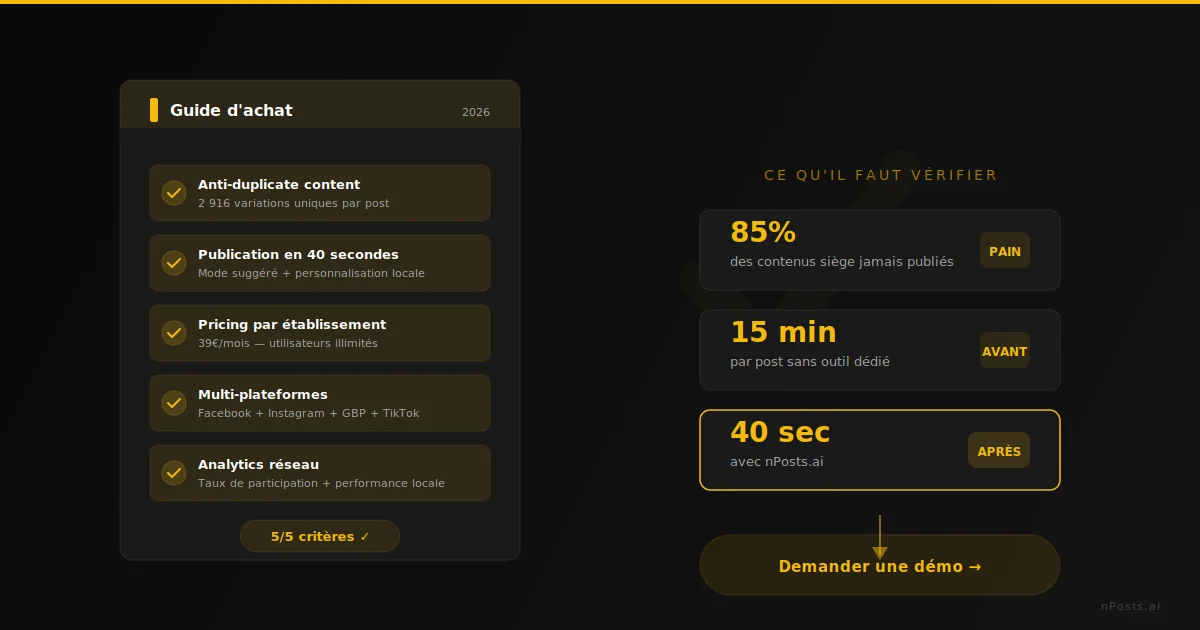
Most franchise marketing teams end up in the same bind: carefully crafted content created at headquarters, sent out by email to every location, and never published in 85% of cases. Franchisees have a business to run. The email gets buried. The post never goes live.
This guide offers a practical answer to that reality. It covers the three organizational models available to you, the criteria for choosing your publishing platform, a six-step workflow, and the rules for balancing local personalization with brand consistency. Whether you manage 10 or 500 locations, the framework is the same.
See also: the complete guide to social media management for franchise networks
The 3 Multi-Location Management Models
Before discussing tools or workflows, the first decision is organizational: who controls what? Three models exist, each with its own strengths and limits.
Centralized model: HQ manages everything
In this model, the headquarters marketing team creates and publishes all content directly on every local page. Franchisees play no role in the process.
Advantages:
- Absolute brand consistency
- No franchisee training required
- Full control over every published message
Limits:
- Generic content with no local relevance
- Enormous workload for the HQ team (it scales linearly with the number of locations)
- Lower engagement: a local audience responds less strongly to content designed for everyone
Best for: networks with fewer than 10 locations, or heavily regulated sectors where every communication must go through legal review (banking, healthcare, pharmacy).
Decentralized model: each location manages itself
The exact opposite. Each franchisee is fully responsible for their own social media presence. HQ does not intervene, or barely so.
Advantages:
- Authentically local content
- Zero workload for headquarters
- High-performing locations can do very well
Limits:
- Total inconsistency in brand image from one location to another
- 70 to 80% of franchisees will publish nothing
- Risk of inappropriate posts with no way to intervene
Best for: almost no one. The variance in results and the reputational risk make this model difficult to sustain at network scale.
Hybrid model: HQ creates, franchisee publishes (recommended)
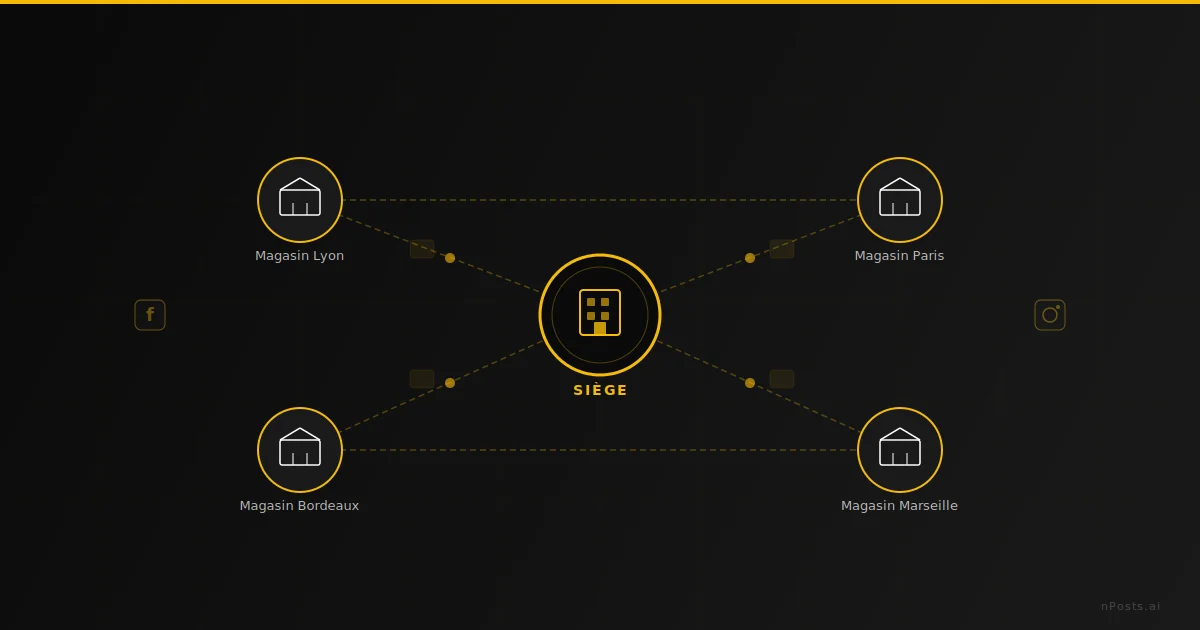
The hybrid model synthesizes the previous two. HQ creates content and makes it available to franchisees through a centralized platform. The franchisee receives a push notification, sees their already-personalized post (store name, city, address), and publishes with a single tap.
Advantages:
- Brand consistency maintained without rigidity
- Automatic local personalization
- Franchisee retains ownership of their page
- Publication rates can reach 80%+
Limits:
- Requires a dedicated platform
- Requires a minimum level of franchisee buy-in (which the simplicity of the process helps achieve)
Best for: the vast majority of franchise networks, from 10 to more than 500 locations.
Comparison table: the 3 models
| Criterion | Centralized | Decentralized | Hybrid |
|---|---|---|---|
| Brand consistency | Excellent | Poor | Good |
| Local content | None | Excellent | Good |
| HQ workload | Very high | None | Moderate |
| Publication rate | 100% | 15–25% | 70–85% |
| Engagement | Low | Variable | High |
| Scalability | Limited | Unlimited | Excellent |
| Reputation risk | Low | High | Low |
Choosing Your Multi-Location Publishing Platform
Once you have committed to the hybrid model, everything depends on the quality of the platform connecting headquarters to the locations. This is not a secondary consideration — it is the engine of the entire system.
Key selection criteria
Number of pages managed simultaneously
A tool designed for 5 accounts behaves very differently when handling 500 pages. Verify that the platform was architecturally designed for multi-site operations from day one, not simply adapted after the fact. A good test question for vendors: “What is your largest customer in terms of connected locations?”
Local personalization vs shared content
The platform must allow HQ to create a single post that automatically transforms into as many versions as there are locations. This dynamic personalization relies on variables — store name, city, address, phone number — injected automatically at the moment of publication.
Content deduplication
This is the most frequently overlooked criterion and the most expensive one to ignore. When 100 Facebook pages publish identical text with the same image, Meta’s algorithm detects the duplication and reduces organic reach by up to 80%. We explore the duplicate content problem in depth in a separate article. A serious platform generates automatic text variations so that each location publishes a technically unique post while delivering the same brand message.
Analytics by location
Knowing that your network reached 500,000 impressions is not useful if you cannot identify which locations are performing and which are stagnant. Analytics must enable inter-location comparison and rapid identification of locations that are not publishing.
Tool comparison table
| Tool | Primary strength | Deduplication | Franchise-ready | Indicative pricing |
|---|---|---|---|---|
| nPosts.ai | Built for multi-site networks, mobile-first franchisee workflow | Yes (2,916 variations) | Yes, natively | From $59/location/month |
| Hootsuite | Wide platform coverage, reporting depth | No | Partially | From $99/month (10 profiles) |
| Buffer | Ease of use, low entry price | No | No | From $6/channel/month |
nPosts.ai was built specifically for franchise networks. Multi-site distribution, deduplication, and the 40-second franchisee workflow are native functions, not bolt-ons.
Hootsuite remains relevant for community managers handling a small number of accounts. At scale, the absence of deduplication and per-user pricing make it difficult to deploy across a network of 100+ franchisees.
Buffer is an excellent tool for a small business or a solo operator. It was not designed to handle the large-scale distribution challenges of a franchise network.
Full comparison: social media tools for franchise networks 2026
Multi-Location Publishing — Step-by-Step Workflow
Here is the operational workflow to implement effective multi-site management, from the initial audit to ongoing performance tracking.
Step 1: Page inventory (audit)
Before touching any tool, create a spreadsheet listing every online presence for every location:
| Location | Facebook page | Google Business | Status | |
|---|---|---|---|---|
| Chicago Downtown | Claimed | @chicagodowntown | Claimed | Active |
| Dallas North | Orphaned | None | Not claimed | Inactive |
| Miami Beach | Claimed | @miamibeach_brand | Claimed | Active |
You will consistently find orphaned pages (created by former franchisees or customers, with no admin access), unclaimed Google Business profiles, and brand inconsistencies. This inventory is your measurable starting point.
Step 2: Connect pages to the central platform
Once the inventory is complete, connect all pages to your platform. This process requires each franchisee to grant access via the OAuth protocol (Facebook, Instagram) or for HQ to claim the Google Business profiles.
Allow two to four weeks for this phase if you have more than 50 locations. Some pages will require access recovery work.
Step 3: Build the shared editorial calendar
Define a publication schedule at the HQ level: monthly themes, seasonal campaigns, target frequency per week, target platforms. This calendar becomes the central thread that the platform distributes to each location.
Minimum recommended frequency: 3 posts per week per location, across at least two platforms (Facebook and Google Business first, Instagram second).
Step 4: Define the local personalization rules
Document in writing what HQ mandates (brand text, visuals, tone) and what the location can adapt (adding a local comment, adjusting the publication time, mentioning a nearby event). These rules must be simple, binary, and easy to verify.
Step 5: Schedule and batch publish
HQ schedules publications several days or weeks in advance from the central dashboard. The platform automatically generates text variations (deduplication) and pushes notifications to franchisees. They receive their personalized post and publish with one tap.
For urgent campaigns or crisis communications, HQ retains the ability to publish directly to all pages without waiting for franchisee action.
Step 6: Track performance by location
Every week, check the analytics dashboard to identify:
- Locations that have not published in more than 7 days
- Posts that generated exceptional engagement (to replicate)
- Locations that are outperforming the network average
Local Personalization vs Brand Consistency
The tension between “speaking to everyone” and “speaking to someone” sits at the heart of multi-location content strategy. The 80/20 rule is the best compass.
What to standardize (80% of content)
The common foundation shared by all locations guarantees the consistency that consumers perceive, regardless of which city they are in.
Always standardize:
- Tone and communication register (vocabulary, level of formality)
- Visual identity (colors, typography, image formats)
- Core brand messages (values, promises, positioning)
- National campaigns and central promotions
- Publication frequency and scheduling windows
What to personalize (20% of content)
Local authenticity is what separates a post shared by a neighbor from one broadcast by a national brand. Locally anchored content consistently generates higher engagement than generic content.
Give locations control over:
- Local hours and practical information
- Location-specific promotions
- Team introductions and behind-the-scenes content
- Local events (neighborhood sponsorships, grand reopening, community involvement)
- Local customer reviews and testimonials
The 80/20 rule in practice
A well-constructed national campaign post with dynamic variables represents the 80%: the main text is standardized, but the store name, city, and address are injected automatically. For the 20% local layer, the platform allows the franchisee to add a personalized line, or to submit content that HQ reviews before publication.
This system creates visible consistency without the rigidity of content that is strictly identical from one location to the next.
Measuring Performance by Location
Multi-location management does not end at publication. Location-level analytics is what transforms a content distribution operation into a measurable growth lever.
Essential KPIs
Engagement
- Average engagement rate per post, per location
- Organic reach vs paid reach
- Monthly follower growth per location
Activity
- Publication rate (% of locations active in a given week)
- Number of posts published per location per month
- Average delay between HQ send and franchisee publication
Business impact
- Clicks to the website or booking page
- Calls generated (if call tracking numbers are available)
- In-store traffic attributable to social media
Inter-location benchmarking
One of the major advantages of a well-configured multi-site platform is the ability to compare the performance of 100 locations in a single dashboard. Networks that encourage franchisees to become active local publishers also benefit from an advocacy multiplier — employee advocacy ROI statistics consistently show that content shared by engaged individuals reaches 8x more people than brand-page-only publishing. This comparison quickly reveals:
- Leading locations whose practices should be replicated (what types of posts are they publishing? at what times? with what visuals?)
- Lagging locations that need specific support (training, re-engagement, process simplification)
- Local markets where competition is stronger and that require higher content investment
Identifying under-performing locations
A location that has not published in 14 days should trigger an automatic alert in your dashboard. The reasons are usually simple: the franchisee changed phones and lost their login credentials, they missed the notification, or they are going through a difficult operational period.
A 10-minute phone call is often enough to unblock the situation. Without systematic tracking, these locations remain invisible for months.
Frequently asked questions
What is the best organizational model for managing social media across multiple locations ?
The hybrid model is recommended for the vast majority of franchise networks. Headquarters creates the content and makes it available through a centralized platform, while the franchisee publishes with a single tap from their phone. This model achieves publication rates of 80% or higher, compared to an average of 15% without a dedicated tool.
How long does it take to deploy a multi-location publishing platform ?
Allow two to four weeks to connect all pages for a network of 50 locations. The longest phase is recovering access to orphaned pages and configuring OAuth permissions. With nPosts.ai, the first posts can be distributed within the first week on pages that are already connected.
How do you prevent duplicate content penalties on Facebook across multiple pages ?
Anti-duplication relies on three combined techniques: text rotation (multiple versions of the same message), dynamic variables (store name, city, and address injected automatically), and staggered scheduling between locations. nPosts.ai automatically generates up to 2,916 variations from a single post.
What posting frequency should each franchise location maintain ?
The minimum recommended frequency is 3 posts per week per location, across at least two platforms (Facebook and Google Business as a priority). This consistency sends a positive signal to algorithms and maintains the local visibility of each location.
How do you measure social media performance by location ?
The essential KPIs are the publication rate (percentage of locations active each week), average engagement rate per post, organic reach, and clicks to the website or Google Business Profile. A multi-location platform like nPosts.ai lets you compare these metrics across all locations from a single dashboard.
Conclusion
Managing the social media presence of 50 or 100 locations is not 50 times the work of a single account. It is an organizational and distribution problem with a clear technical solution.
The path is well-defined:
- Choose the hybrid model (HQ creates, franchisee publishes)
- Adopt a platform built for multi-site operations with native deduplication
- Apply the 80/20 rule between standardized and local content
- Track each location’s publication rate every single week
Networks that follow this framework move from a 15% publication rate to 80%+ in under six months. The difference is not budget or creativity. It is the system.
Ready to transform your franchise network’s social media management?
Related articles
- Social Media for Franchise Networks: The Complete Guide 2026
- Social Media Tools for Franchise Networks: Full Comparison
- Facebook Engagement Rate: How to Improve It for Franchise Networks
- How to Manage Multiple Facebook Pages for a Franchise Network
- Franchise Social Media Management: Buyer’s Guide
nPosts.ai is the multi-site publishing platform built for franchise networks. One piece of HQ content becomes hundreds of unique posts, published by your franchisees in 40 seconds. Discover nPosts.ai
![SOCi Alternatives: 5 Best Franchise Social Media Tools [2026]](/images/blog/en/social-media-tools-franchise-comparison/social-media-tools-franchise-comparison.png)