Why 73% of Social Media Guidelines End Up in a Drawer
I remember an optical franchise network with 40 stores. They invested 8,000 euros in a 50-page social media guideline, created by a reputable agency. Beautiful, comprehensive, professional. And completely dead by the third month.
The franchisees never opened it.
That struck me at the time. I’d been working with optical franchisees for years (Afflelou, then as a consultant afterward), and I kept seeing the same pattern: you create guidelines, distribute them with enthusiasm, and then… radio silence.
Why? Three reasons I saw repeat themselves:
-
Too long — 50 pages is a compliance manual, not a guide. Franchisees are busy; they’re not going to dissect a 50-page legal document to find out if they can post a photo of their store. They want the answer in 2 minutes, tops.
-
Too restrictive — The guidelines banned everything that wasn’t explicitly approved. Result? A salon manager who wanted to show off her latest creation (impeccable work) asked herself: “But am I allowed to?” Rather than risk it, she posted nothing. She just… gave up.
-
Frozen in time — Instagram changed its formats, TikTok exploded, Google Business Profile added features. The guidelines? Still from 2023. So after 6 months, nobody was reading them anymore.
The major mistake I see: People think guidelines work through constraint. Spoiler: they don’t. They only work if they reduce friction for the franchisee.
The 7 Essential Sections of a Franchise Guideline
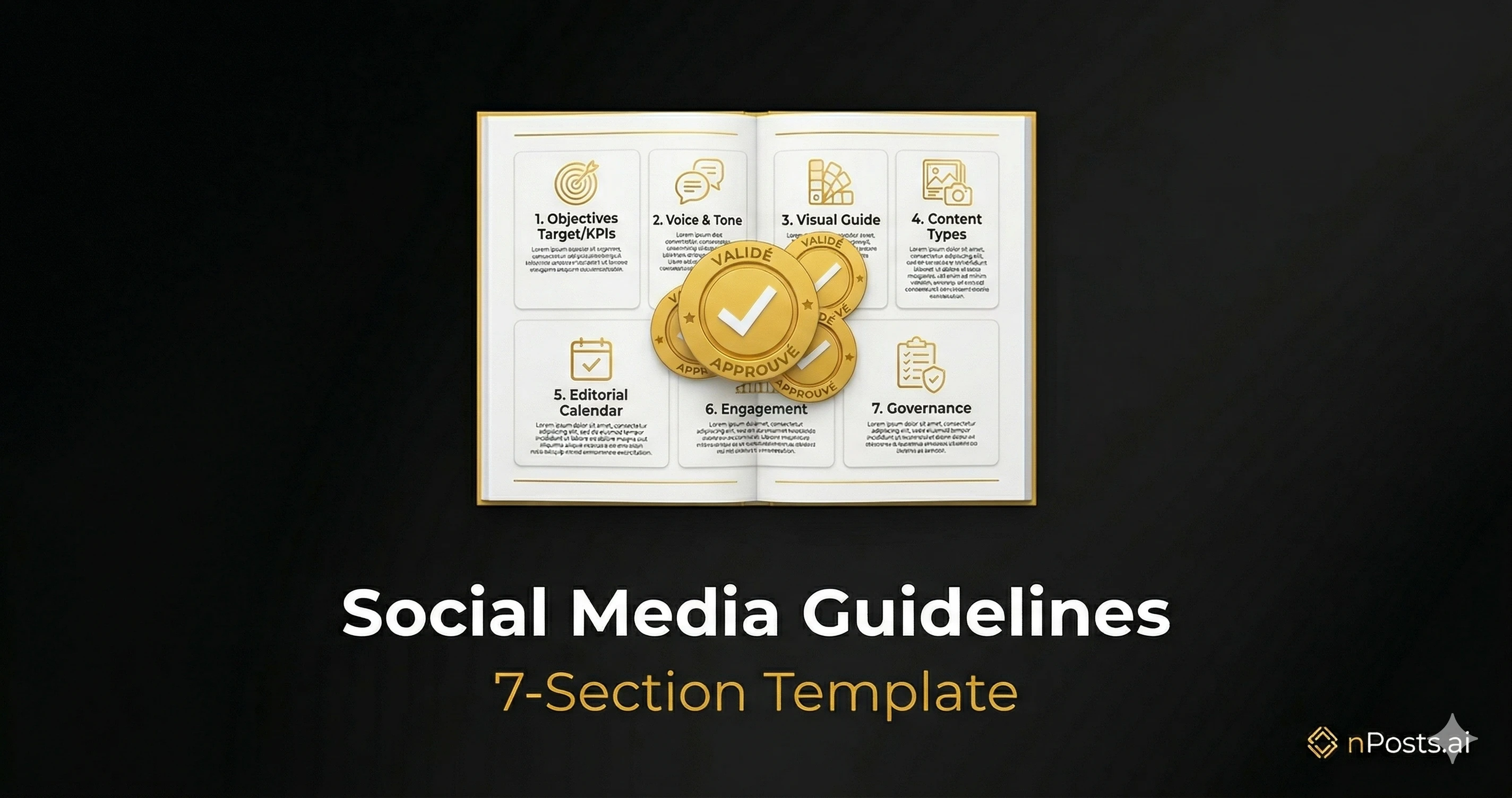
If you’re starting from scratch or revamping your guidelines, stick to these 7 sections. Nothing more, nothing less.
1. Objectives and Brand Positioning
What is it? One sentence explaining why you’re on social media.
Don’t say: “Increase our digital presence.”
Say: “Connect our customers with the creators, events, and energy of their local community.”
That’s the difference. The first is hollow jargon. The second, a franchisee can understand in 5 seconds and use to decide whether to post or not.
Include:
- Primary objective (engagement? foot traffic? hiring?)
- Overall tone (inspiring, humorous, informative?)
- Main audience (existing customers, prospects, staff?)
- 2-3 real posts from your network that embody this positioning
Each franchisee should be able to answer “If I post this, what’s the point?” in less than 10 seconds. If it takes longer, your guidelines aren’t clear enough.
2. Visual Identity
This is the one place you need to be really strict. Why? Because visual consistency is what makes you instantly recognizable: “Oh, this is a post from my franchise.”
Without it, your posts get lost in the noise. Your franchisees become anonymous Instagram accounts that could be anyone else.
Include:
- Color palette with HEX codes (primary, secondary, neutral)
- Authorized fonts (one primary, one secondary)
- Image dimensions for each platform (square Instagram, vertical TikTok, banner Facebook)
- Logo: full version, simplified version, minimum clearance
- Approved filters/effects (or not)
- Watermark or signature if applicable
Pro tip: Create a small visual guide with concrete screenshots, not pages of text. Franchisees read a table with examples better than theoretical explanations.
For more on this topic, our complete guide to visual identity on social media explains how to build a cohesive identity across all platforms.
3. Tone and Vocabulary
How do we talk? 90% of guidelines forget this question. And that’s a major mistake.
Look: you don’t talk the same way on TikTok (relaxed, trendy) as on Google Business Profile (professional, factual). But your brand voice? It should stay recognizable everywhere.
That’s the difference between content that sounds like your franchise and content that sounds generic.
Include:
- Approved vocabulary (industry jargon, but explained for franchisees who don’t use it daily)
- Forbidden words (overly technical jargon, discriminatory language, outdated terms)
- Formality level: “Hi!” or “Welcome”?
- Posture: expert, colleague, friend?
- 3-4 template sentences for different contexts (promotion, education, engagement)
Example for a salon franchise:
- ✅ “We’ve got a personal trick for you” (approachable, friendly)
- ❌ “It should be noted that our hair services possess beneficial properties…” (too formal, too distant)
4. Publishing Calendar and Frequency
How often should you post? This is a question where most guidelines derail.
They say “3-4 posts/week on Instagram” and stop. But a solo fitness franchisee doesn’t know if it’s 3 or 4. Doesn’t know what time to post. Abandons the whole thing.
Include:
- Recommended frequency by platform:
- Instagram: 3-4 posts/week
- Facebook: 5-7 posts/week
- TikTok: 2-3 posts/week
- Google Business Profile: 2-3 posts/week
- Optimal posting hours for your industry
- Days to avoid (competitor sales, summer closures)
- Annual editorial calendar with monthly themes
- One line on flexibility: “You can post outside the calendar if it makes sense for your local context”
Important: Flexibility isn’t a weakness. It’s a strength. A franchisee who spots a local opportunity (an event, a happy customer) shouldn’t need HQ approval to seize it.
5. Do’s and Don’ts
This section gets read the most. Make it visual and actionable.
Include (checklist format):
DO:
- ✅ Show your happy customers (with permission)
- ✅ Ask questions to create dialogue
- ✅ Reply to comments within 24h
- ✅ Adapt HQ content to your local context
- ✅ Share behind-the-scenes and human moments
DON’T:
- ❌ Post the exact same content across all platforms
- ❌ Ignore negative comments
- ❌ Share political or religious content without approval
- ❌ Copy competitors (too obvious)
- ❌ Sell only: entertain, educate, and engage first
6. Content Validation Process
How is content approved before publishing? Be clear on this.
Include:
- Who approves? (HQ? marketing manager?)
- For what type of content? (everything? only major announcements?)
- Expected response time
- Who approves sensitive content? (aggressive promotions, HR topics, crises)
- Approval platform (email, social media management tool, other)
Pro tip: Keep it simple. If you require approval for every post from every franchisee, you create a bottleneck. Better to have clear guidelines and exception-only approval.
7. Crisis Management and Moderation
It happens: negative comments, local controversy, an article criticizing your network.
Your franchisees need to know how to respond.
Include:
- Who to contact in a crisis? (directly? through support?)
- How to respond to negative comments (example of appropriate response)
- When to escalate to HQ
- Comment deletion policy (if applicable)
- How to handle problematic DMs
- Who manages social media during a real crisis (HQ or franchisee?)
Good example of responding to critical feedback: “Thank you for your feedback, it matters to us. The points you mention are important. Could you send us a DM so we can explore this together?”
Adapting Guidelines by Platform
Your guidelines are the trunk. Platform adaptations are the branches.
| Platform | Tone | Frequency | Primary Format | Key Specificity |
|---|---|---|---|---|
| Friendly, informative | 5-7 posts/week | Mix content + promotions | Long discussions welcome | |
| Visual, aspirational | 3-4 posts/week | Carousel, Stories, Reels | Aesthetics matter, short captions | |
| TikTok | Authentic, playful, trend-aware | 2-3 posts/week | Short videos (15-60s) | Sound/music critical, ephemeral trends |
| Google Business Profile | Professional, factual | 2-3 posts/week | Photos, updates, offers | Local SEO + customer reviews |
For each platform, specify:
- Primary objective
- Priority content types
- Content to avoid
- Recommended hashtags
- Partners/influencers: allowed?
For more on Instagram formats, check out our guide to Instagram formats 2025 for franchises.
How to Deploy Guidelines Across Your Network Without Friction
Having beautiful guidelines is good. Getting them implemented is better.
Phase 1: Initial Training (Week 1-2)
- Video call with all franchisees or in small groups
- Simple presentation: 30 min max
- Q&A to clarify questions
- Send a one-page summary by email after
Pro tip: Show concrete examples of “good” and “bad” posts for your network. Franchisees relate better to reality than abstraction.
Phase 2: Startup Kit (Right After Training)
Franchisees retain only 30% of what you explain. Give them:
- One-page summary (objectives + do’s/don’ts)
- 3-5 ready-to-use templates
- Visual guide (color palette, post examples)
- Short FAQ (the 5 most common questions)
- Contact for a lead to address specific questions
Put everything in a shared Google Drive or your management tool (like nPosts.ai, if you use it).
Phase 3: Support and Templates (Month 1-3)
- Progressively enrich the template library
- Create a central editorial calendar that franchisees adapt
- Answer questions
- Identify network “champions” who follow guidelines well and use them as models
Phase 4: Regular Check-ins (Ongoing)
Monthly or quarterly:
- Review published posts
- Positive feedback on what’s working
- Clarifications on confusing points
- Update guidelines as new formats emerge (Instagram Stories this month, TikTok Trends next month)
Key to success: Dead guidelines are guidelines that don’t evolve. Update at least quarterly.
Measuring Adoption: KPIs to Track
How will you know if your guidelines are working?
1. Publishing Rate
Metric: % of franchisees posting at least 1x/month.
- Before guidelines: 30%
- 3 months after: 65%
- 6 months after: 80%+
This is the first indicator. If franchisees aren’t posting, your guidelines didn’t reduce friction.
2. Design Consistency
Review 20 random posts per month. What % follow:
- Color palette?
- Fonts?
- Logo visible?
- Format adapted to platform?
Target 85%+ after 2 months.
3. Comment Response Time
How long before a franchisee responds to a comment?
- Before guidelines: 48h
- After guidelines: 12h
This signals that franchisees are integrating social management into their job.
4. Average Engagement per Post
Look at engagement (likes + comments + shares) by platform, before and after.
- Instagram: +25-40% possible
- Facebook: +15-30% possible
- TikTok: variable based on content
- Google Business Profile: +10-20% on direction clicks
Note: Engagement increases mainly if your guidelines help make content local and authentic, not uniformly templated.
5. Brand Consistency (Qualitative Audit)
Every quarter, ask yourself: “If I saw 10 random posts from the network, would I recognize the brand?”
If yes, you’re good. If no, your guidelines aren’t communicating brand vision.
In practice: Where to measure this? If you have a centralized tool (like nPosts.ai), these metrics calculate automatically. Otherwise, it takes manual work.
FAQ — Franchise Social Media Guidelines
”Why 7 sections? Why not 10 or 5?”
Because 7 is the balance point. Fewer, and you leave gaps that franchisees will fill with their own interpretations. More, and you create bureaucracy.
I tested this working with several networks (optical, salon, fitness). 7 sections is the number that minimizes “Am I allowed to post this?” while staying readable and actionable.
”A franchisee is completely ignoring the guidelines. How do I respond?”
First, be honest: maybe it’s not a franchisee problem. Maybe it’s a guidelines problem.
Verify they received and understood them first. Then ask yourself: are they too rigid? Not relevant to their context? Too complicated?
If you honestly answer yes, change the guidelines. Don’t force it.
If a franchisee is genuinely ignoring clear and relevant guidelines, then escalate. But guidelines never work through force; they work through relevance. A franchisee who feels they’re helpful will follow them. One who feels they slow them down will ignore them, contract or not.
”How often should I update guidelines?”
Minimum every 3 months. Social media changes constantly. TikTok launches formats, Instagram pivots algorithms, Google Business Profile adds features. If your guidelines are still from 2023, they’ll be dead by 2026.
Every quarter, check in:
- Is there a new platform relevant for my network?
- Do my frequency/timing recommendations still hold?
- What confusion points exist among franchisees?
- Do I need to add or remove a section?
And don’t just silently update. Send a note: “Quarterly update: here’s what changes and why.” This shows franchisees you’re active, not just sitting on dead guidelines.
What Research Says About Effective Social Guidelines
I looked at data on this (Social Media Today, 2024, ~200 multi-location networks). The pattern is clear: networks with living, short, visual guidelines succeed 3x better than those sending a 50-page PDF.
Winning criteria:
- Visual format (checklist, images, real screenshots): +45% adoption
- Example of actual “good post” from your network: +35% adoption
- Update at least every 3 months: +28% adoption
- Under 10 pages: +52% adoption
Here’s what we see in practice: when guidelines are short, visual, and updated, franchisees read them. When they stagnate, nobody touches them.
But I should also note: some networks have no guidelines at all and rely instead on a strong central template (rather than editorial guidelines). Results? Similar. Even better, sometimes.
Why? Because a good template is more useful than beautiful guidelines that paralyze.
Guidelines Are Just the Beginning
Guidelines set the framework. But for them to really work, you need two more things:
-
Ready-to-use templates — This is the real key. If the franchisee has to create from scratch every time, friction returns immediately. But if you give them adaptable templates (with color palette, caption structure, image dimensions), creation time drops 80%. They can focus on creativity, not rules.
-
A shared editorial calendar — “What should I post?” is a real question. If you just say “post 3-4 times a week” without offering content, the franchisee panics. But if you say “here’s a monthly calendar you adapt locally,” posting becomes almost automatic.
That’s why tools like nPosts.ai exist: the platform automatically generates variations of HQ content for each franchisee (adapted to their local context). Guidelines define the rules, the tool applies them. Win-win.
Conclusion: A Living Guideline Is a Followed Guideline
If I had to give you one piece of advice: a successful network doesn’t see guidelines as a frozen document to enforce, but as an ongoing conversation with franchisees.
Why? Because franchisees who post regularly, genuinely engage their customers, and maintain brand consistency didn’t do it because they had to. They did it because the guidelines made their life easier, not harder.
It’s simple, but it’s the difference between success and failure.
If your guidelines create friction (bureaucracy, excessive control, rules that don’t make sense), they’ve failed. Scrap them and start over.
If they create clarity, trust, and autonomy? They’ve succeeded.
Ready to implement your guidelines? The essential: make sure your franchisees can post without friction. Discover how nPosts.ai simplifies this by centralizing control and decentralizing action.
To deepen your franchise social strategy, see our guide on local marketing in franchises.
Key Takeaways
- Guidelines that are too long (50+ pages) end up unused. Aim for 7 sections maximum.
- The 7 key sections: objectives, visual identity, tone, calendar, do’s/don’ts, validation, crisis management.
- Deploy progressively: training → startup kit → support → regular check-ins.
- Measure via 5 KPIs: publishing rate, design consistency, response time, engagement, brand consistency.
- A living guideline (updated every 3 months) is 3x more adopted than a frozen one.
- What matters isn’t the guideline itself, but the friction reduction it brings to franchisees.